[00:00:08] Speaker A: Good planets are hard to find Now.
Temperate zones and tropic climbs and run through currents and thriving seas.
Winds blowing through breathing trees, Strong ozone and safe sunshine.
Good planets are hard to find. Yeah.
[00:00:35] Speaker B: Hello K SQUID listeners. It's every other Sunday again and you're listening to Sustainability Now, a bi weekly case Good radio show focused on environment, sustainability and social justice in the Monterey Bay region, California and the world. I'm your host, Ronnie Lipschutz. How might we think about the future? And is there any way to get to the futures we might desire? The French historian Fernand Braudel created a three tiered approach to thinking about history.
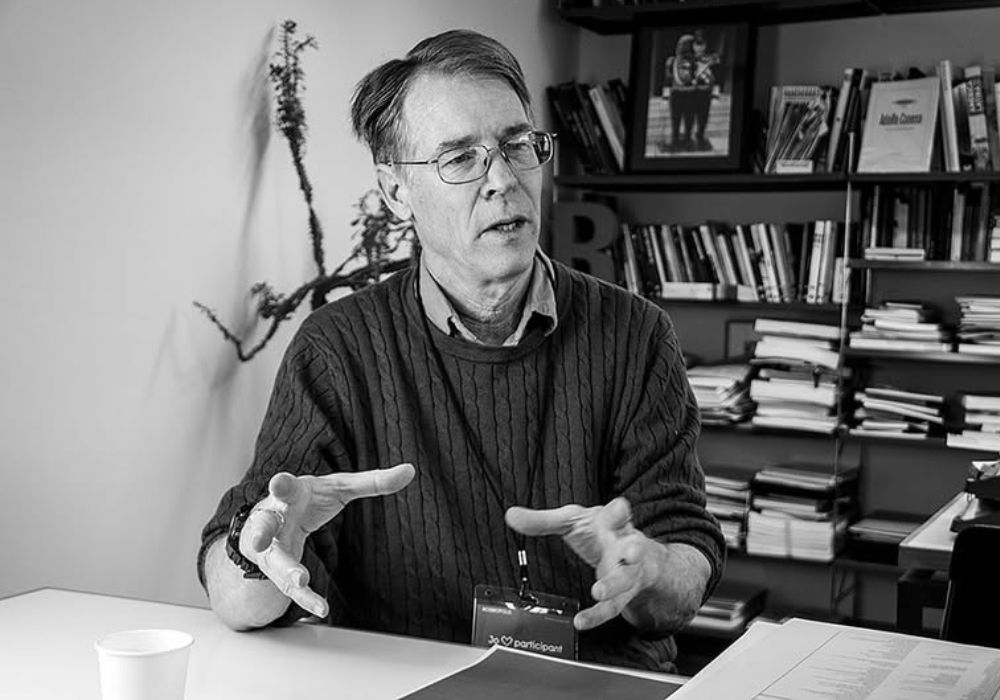
The long dure or geographic time, la conjuncture or generational time, and histoire eventamentiel, the event or what happened yesterday or last year. This is a useful framework for thinking about the future, the long future, the conjunctural future, and the near future. All of them are more or less about imagining futures, which is never really about the future, but closer to commentary about how the present may might unfold. My guest today is Kim Stanley Robinson, best known for his 2020 book the Ministry for the Future and more recently the High Sierra, A Love Story, which is a conjunctural memoir. Robinson has written more than 20 books, many of them science fiction based conjunctural futures. He's received many honors, both for his writing and his struggle on behalf of nature. He was last my guest on Sustainability now almost exactly six years ago, on August 23, 2020, the Ministry for the Future was published about six weeks later. We were in the early stages of the COVID pandemic and a presidential election was looming. Well, we all know how those things turned out. Stan Robinson, welcome back to Sustainability Now.
[00:02:12] Speaker C: Thanks, Ronnie. It's good to be with you.
[00:02:14] Speaker B: In getting ready for this conversation, I read the High Sierra. I looked at some of your recent interviews and podcasts. I didn't want to duplicate what you had been covering in that. And then I thought a lot about what we might talk about. And as a recovering academic and critical theorist, I think it's important to think critically about the future and, and how we might shape it. And so I came up with this notion of conjunctural futures. And as I mentioned in the introduction to the program, I took this from Fernand Braudel. Conjunctural history is generational and so conjectural future is more or less generational. And you know, and in reading your, your books, I imagine you as something of a conjunctural futurist rather than someone who, who looks far into the future and writes space opera. Yes, but I wanted to start with the following. On August 4th of this year, NPR ran a segment about Ray Bradbury's 1950 story there will Come Soft Reigns, which I imagine you remember.
[00:03:16] Speaker C: Yes.
[00:03:16] Speaker B: It appeared in Colliers and in the Martian Chronicles, and for our listeners who are not familiar with the story, it recounts the operation of what we would today call a smart house located in Los Angeles the day after a nuclear exchange. What was interesting is the Collier's article takes place in 1985, which is much more conjunctural, whereas the Martian Chronicles story, at least in the editions I have, say, August 4, 2026.
So to start with, I'm curious about what impact that book might have had on you and your writing. And is this a good example of a conjunctural future as I've tried to define it?
[00:03:54] Speaker C: I think so. I was a student of Frederick Jameson, and he sent me to Braudel as one of the annalists studying history by way of not just the generals, kings and queens and wars, but daily life and changes over the generation in technological bases and numbers of people.
And that was very influential for me in terms of writing things like my Mars Trilogy or the Years of Rice and Salt.
So I think I know what you're talking about. And I often say that science fiction being story set in the future, can be split pretty neatly into three parts. There's near future science fiction, essentially, now pushed a little bit. There's space opera, which is a kind of fantasy where you're out in the galaxy, zipped around faster than light, and it's maybe thousands or millions of years in the future and magic obtains, but with a technological cover story. And then the mid zone I've been very interested in, and I wonder if that matches what you were talking about with conjunctural about 200 years out. You can't predict it, but you can feel that we're headed in that direction. And it's an interesting zone. There are many fewer science fiction stories set, say, 100 to 300 years in the future than there are near future or far future. But I've often enjoyed that zone. And that brings me to Bradbury, who he didn't do space opera. He wrote about the present with a kind of a surrealistic, poetical touch of his own. He was brilliant in his sense of the short story as an emotional engine or machine to make you feel things.
And of course, I had to look very deeply into his Martian Chronicles when I was writing my Mars novel. And it's really good.
But it comes from the early forties and his knowledge of Mars is minimal, as was true for everybody then. It was an orange dot in the sky.
So he used it as a space to talk about what was going on in america during the 30s, the war years and then the post war period and indeed after the Hiroshima and Nagasaki. Then he, like many science fiction writers in the 50s, was very concerned about nuclear annihilation. And that's a beautiful short story. There will come soft Rains because the Smart House, essentially an AI and not quite sentient, but very attuned to its own feedback systems and semi aware of what's going on and reporting on the sudden absence of all people and functioning quite well in the radiation that's killed other people, at least for a while, till the electricity runs out or its batteries. It's one of those shocker stories that was famous in its time along with on the beach and Fail Safe.
Alas Babylon, the science fiction in the 50s that was about nuclear annihilation, Canticle for Leibowitz and many and many a short story were warning signs that were being sent out by the community, the science fiction writer writing community, that humanity was in great danger and needed to come to grips. And the humanity responded to these stories in the nuclear non proliferation treaties and the anti test bans. The danger was made vivid to people by way of these stories.
So I feel it, it was, it was a public service. But it's what literature is supposed to do in at least in its science fiction version.
Lay out scenarios of future possibilities and they can be good or bad. And then we make choices in the present trying to go for the good and avoid the bad.
[00:07:49] Speaker B: What do you think drives history and drives us toward the future? I mean, is it technology in your view, or is it, you know, human social behavior?
[00:07:59] Speaker C: Well, the two are so tightly linked that you can hardly pry them apart. And indeed technology, you want to take the largest version possible of that word and that concept. You want to say this, that technology existed before human beings did.
The hominids that we evolved from, they used stone tools, they used fire.
And these were early technologies that we co evolved with to make us Homo sapiens. In other words, there were previous versions of, of hominin primates that by using these tools turned into human beings. Another one, crucially, is language.
That's a biggie. And that's a communication system, that's a social system that didn't exist before. This is fuzzy territory. We don't know exactly when language appeared in the human record. And we don't know how it first appeared or what its earliest effects are, but it's pretty obvious when you take the longest view that our brains grew by, I don't know, by an unbelievable factor. I'm forgetting the exact percentage, but maybe by a third about the time that language came along.
And that meant that we could become a team players with each other. We had social systems that immediately developed problems of its own, like who gets to say what to do, who controls what the. Everything that has to do with politics came with language. And then the technology changed also. So you get the various improvements in our ability to cope with nature in a feedback loop. That language was the crucial step in terms of social systems within social arrangements.
You go from the Paleolithic, so called hunter and gatherers, nomadic, to agriculture. That's huge. That's a technology.
And it, and it goes on like that through history.
So history is about that interplay between humanity and its environment, the planet itself, and then our, the tools we used, including language. And then I also have been saying these last many years that one could consider justice to be a technology. It's a software rather than a hardware. But because we now have computers as a great analog or metaphor for how we act, you know that computers are not just the hardware and that if there's a software crash, the hardware is useless.
So in the software of running humanity in history itself, amongst that is justice and equality as social technologies that can work or not work. At that point people are often throwing up their hands. They're saying, well, you've just destroyed the word technology. Because I thought it just meant machines.
And by talking about women's rights as a technology, as equality and justice as a technology, I may have blown the word up, but I did it on purpose.
[00:11:08] Speaker B: I'd like to use the word technics. And I, I haven't been able to figure out where that came from.
[00:11:13] Speaker C: I think it came from Lewis Mumford.
[00:11:15] Speaker B: It may have, may well have come from Mumford. Maybe that's where it was. But you know the idea that, that techniques have to do with practices.
[00:11:23] Speaker C: Yes.
[00:11:23] Speaker B: And then, then technology is, is the hardware. Technics is the software.
[00:11:29] Speaker C: Yeah. And it rhymes with or, it sounds a lot like or it's the same word as techniques. And we, we understand techniques to be practices.
[00:11:38] Speaker B: Right, right. But you know, the obvious question is, is artificial intelligence as it is being, you know, brooded about today, a technology that is driving us in a particular direction? In a sense, the technological determinism seems to be dominant in this particular sphere in terms of the struggle amongst, you know, big tech companies and the, the near futures, I guess that are being written about.
Yeah, there's a lot of human intervention obviously. But on the other hand there isn't a lot of thought or a lot of control or management it seems.
[00:12:17] Speaker C: Well, we're in the middle of this story and I'm as confused as anyone. But I have been thinking about AI and its possibilities for a long time. There are competent AIs in my Mars trilogy from the 90s and my novel Aurora is in theory written by an AI. An AI narrator tells the story of Aurora. So I had to think about it hard then. But I still remain confused. And I'm an English major and outside the black box of the current large language models, the large language models are doing some things that I'm surprised they can do and I believe that the makers of them are surprised that they can do these things and not fully comprehending what's happening inside the black box when the algorithms combine and, and recombine.
But also I think they're over impressed by the potentialities that we're now hitting limits on the inaccuracies. This so called hallucinations are simply mistakes.
So fancy names don't disguise the thing that these, these LLMs are not sentient. They're really like what's the most likely word to come next in a probabilistic way fundamentally. And they're hitting their limits. And so there's another thing going on that is more social than, than machine like here, which is simply profit and a bubble. This is a financial bubble and everybody I think who's paying attention is aware and wondering when will the bubble burst? The, the, the IPOs for anthropic and for chatgpt or OpenAI, these, these may not even happen. They're in such danger of being way over their skis and costing way more money to do what they do than any possibility of making a profit in return.
And the financial community is looking at this with a more and more skeptical eye. The bubble may burst and people may be thrown back.
LLMs will still work. And also there's many experts in AI saying we need symbolic logic, we need world modeling. And this is not so easy to add to what LLMs do. And so there's sure to be, it's sure to be the, an ongoing story but part of it is simply a scam financial bubble. People wanting to convince other people that they need hundreds of billions right now and then they will run off to their private island when things crash, and it might take down people's pensions, it might be that there will be government bailouts or that big investments by pension firms will go down with the ship if there's a. If there's a depression following the popping of the AI bubble. So the stakes are high and it's very confusing. But that's my take on it right now.
[00:15:17] Speaker B: You know, as we were talking, it occurred to me that in many ways these, these hallucinations mimic human behavior quite closely, don't they? I mean, there's a sense in which these models which are supposedly going amok are actually just, you know, copying their. Their creators.
Well, I don't know if that's. That's very close. And, you know, and the other thing about probabilistic reasoning, I don't know what you would call it. You know, what's the next most likely word to come in the sentence? I don't know how I write. I write. I don't know how I write. But I'm willing to bet dollars to donuts that a lot of that has to do with putting the next logical word or the word that sounds good after the preceding one. So there is a sense. Right. Again, it's the technic. And I mean, I see that in, in your work as well.
Right is. Which is not to say that it's. It's somehow, you know, dead end or banal. But particular kinds of approaches and ways of writing. Don't take that as some kind of criticism. It's.
[00:16:20] Speaker C: No, no, There's a matter of style. English style.
Like, if I was to say that's a very spry toddler, you would look at me because the adjective spry goes with someone like me. These are spry, old man. Spry means old, but still nimble. You can't apply that adjective to a toddler. So you won't see those two together. Well, this is.
I picked that out because I'm feeling quite stiff this evening.
A little too spry for my own good today. But the language is rife with these kind of combinations that seem right.
And if you contradict them, you can either be original and sparky, or you can just be clumsy and bad.
So it's a judgment call. And many a human writing English prose has made the same judgment based on the earlier prose that they've read.
And this is a matter of good style. But style is also accuracy combined with musicality.
And. And there's always going to be a spark of the original creator's mind in it. So that one Thing about AI Prose is it looks and reads lowest common denominator because it is.
[00:17:37] Speaker B: Well, there's a lot of writing that is lowest common denominator. That's, you know, written by humans. You're listening to Sustainability Now. I'm your host, Ronnie Lipschitz, and my guest today is Kim Stanley Robinson, who is best known for his 2020 book. I think he's best known the Ministry for the Future, but has written many other books about science fiction. And we've been talking about what I was calling conjunctural futures, that is to say, generational futures, which is something that. That Robinson does with great flair.
Let's go on to utopias. Now, I know in. In other interviews you've done in the last, you know, couple of months, you've been asked about utopias, but I guess the first thing I wanted to ask is, why are there so many dystopias in the air and floating around?
[00:18:25] Speaker C: Well, people are scared. It looks bad that you can feel the danger. We're out of. Human civilization is out of sync with the. The biosphere of planet Earth, which is our one and only home. And the biosphere has to be healthy for us to be healthy. And we've poisoned it, not just by carbon dioxide in the atmosphere, heating things up, which is dire enough, but also flatly poisoned with poisons, various pesticides. Everybody knows the list. I won't go into detail, but that feeling of dread, it wants expression. And so people will write the dystopia. If we keep going the way we are, we're going to end up in a bad place.
Now, I've always been against dystopias. I feel like that's so obvious.
And also, it's a kind of a comfort food. You read a dystopia and think, oh, those poor people. You know, like in Galaxy Quest. Oh, those poor people.
And you come back to your uncomfortable existence and say, well, things may be scary for me, but at least I'm not as bad as those people who are fighting off zombies or whatnot. And so it becomes a kind of comfort food and reassurance, and you don't have to do anything, although occasionally one will punch you on the nose and remind you it could get so bad that we really need to change. So it has its purpose.
One can never deny the power of a book like 1984, for instance, or the Hunger Games, the inequality of that period of time the Hunger Games expressed. This is how life feels. It was a surrealism. It didn't make logical sense as history, but it it expressed how things felt. And that's what literature is really for. I figure, okay, other people can do that. What I want to do is write a utopia that you can still believe in. And I want to write utopia as not the perfect place or the end product of history, but rather as a dynamic process of things getting better by human effort, a persistent return to the problems and attempts to solve them. That's utopian history. This is, comes out of H.G. wells. It's not my idea. H.G. wells writes about this very eloquently in his 1905 novel called A Modern Utopia. And he continued writing utopian novels from 1905 to 1945, when he died. And if you think about those four decades, you realize that he was a stubborn man trying to invoke a better world by brute force when things were going very badly.
So I admire Wells. I'm. I'm. I've actually just written up a.
I've collected all the utopian texts from Homer and Plato up till the present and made a little extracts from each in a through line for a theatrical priest that will appear at the Oxford Ministry for the Future at Oxford University on November 23rd of this year.
That was a challenging assignment, harder than I thought, because I thought I knew the utopian literature, but I didn't know it well enough to just call up an hour and a half skating through the history of utopian literature. That took some work, but it was interesting too. You see that the people change over the centuries and what they think good society is. But you see also the similarities of what people persists in, what people think the good society is from. From Homer till now. And I, I say Homer because right before Odysseus gets to Ithaca, he stops at an island where everything is going right.
It's a brief passage, but it's quite beautiful and kind of mind boggling. It's of course not in the movie, it's seldom noticed. I can't remember the name of the island he lands on even. And it's a short passage in a long, long poem, but the idea of a better place, or of a good place where people are getting along in harmony with, in fact, with nature, because in those days in particular, you need good weather, good crops, regularity, peace. You need peace and you need enough to eat.
Well, this, this makes Utopia perpetual and interesting. I had a teacher and a friend, Ursula K. Le Guin. The greatest utopian novel ever written is her book the Dispossessed, which I learned a lot from when I was young and I read it in one night in 1975 or so, a year or two after it came out, actually. And it, it kept me up all night and has informed my work ever since. And then I had a good friend, a Scottish guy, Ian Banks, he wrote his culture series. This is post scarcity space opera utopia, where the AIs are benevolent and funny and things are going well. But in each case, the utopia has to be defended and it has to be sustained. And the problems that it creates, it's so, oh, it's utopia. Everything's perfect. But no, that never happens. There's still problems that begin to screw things up, and that's where you get your story. That's why utopias are not always boring.
Sometimes they are pretty boring. When someone's describing to you how their sewage system works so well, you're thinking, where's the plot? I need, I need some action.
But a utopia, you read an Ian Banks novel, well, there's action galore. And the Dispossessed by Le Guin is intense and gripping. So there can be good novels that have a utopian background. And I've been trying that for, at this point, about 40 years. Not, not every book, but say every third book, I've given it a try.
[00:24:05] Speaker B: What impresses me about that is that you describe the hard work of proceeding into the future. I don't know exactly what, what to call it. So that rather than eliding big stretches of what's going on, you're talking about day to day activities at that level. Right. I mean, I see that in, In Red Mars and, and in California Trilogy. Yes, we talked about last time. Pacific Edge, I think it is.
[00:24:33] Speaker C: That's right. That is my first attempt.
[00:24:35] Speaker B: And, and doing that is hard work because it requires a level of detail and knowledge which, as I've been rereading while reading the Mars books, the knowledge that you exhibit in there and the work that I think that you must have put into learning these things is incredible. How do you do that?
[00:24:56] Speaker C: Well, I like to read.
And up until quite recently I had a good memory.
So if I read something, I remembered it and I read, I read a lot. I, I'm not a visual person. There's many a famous movie I haven't seen and I haven't seen the Golden Age of tv. I just read. And so I, I like reading and I like writing, but. And so it hasn't been work. It's been a pleasure. Oh, I'm interested, I'm curious, I want to learn more. And then the, the trick of it That I must confess, I don't exactly know. I don't have a.
A method that I can describe to other people.
Where is the story in it? How can I reveal this information about systems in characters?
A plot where characters are facing a problem and they're trying to solve it. And the characters are interesting in. In and of themselves as people. Well, that's the novelist's problem in the novelist's art.
And I love it dearly. The information load, the social aspects of the novel.
Those two are interesting and they add an extra problem to the mix characters with a problem. That's plot. Those are the crucial. But then if you want to talk about what you're talking about conjunctural. What if your novel covers 200 years? What if your novel covers 700 years when you're writing an individual scene?
What's worth talking about? Well, I got up for breakfast and I had scrambled eggs and bacon. Can you write that scene when you've got 700 years to cover?
Well, no. So you need to think up ways of dramatic summarization, I guess I would call it. You need what people talk about. The Proust, the critics of Proust, the iterative writing about the things that happened every day in a habitual way. Can you write about that in a way that's still interesting, that doesn't lose the plot in a most literal way? Well, I mean, I've struggled with these problems, especially starting with the Mars trilogy. I began to think differently about how novels are constructed and make up my own solutions that are. They're not original to me, but they cobble together a lot of the 19th century novelists. So instead of sticking with modernism, that you have to be in real time, that you do nothing but dramatization, that you never summarize, that you never have a narrator. Well, I threw all that aside. Of course you have a narrator. Of course you summarize. Of course you do the iterative and you pay attention not to people like the great modernists, whom I love dearly, but more people like Balzac or Garcia Marquez, that do summarization quite beautifully.
So that's how I've solved my problem. And then the utopian content is more of a Political judgments. Okay. People have political lives. They sometimes get very angry. They sometimes it leads to violence.
Let's focus on that to make the story more exciting. I guess you'd come down to it. And I have, like in Pacific Edge or in my daily life in the last five years.
What if you're on the town council?
I wasn't on the town council. Although my characters are in Pacific Edge. Every meeting is so boring. And what you have to understand is things can be boring and interesting. Things can be slow but interesting at the same time. Boring but interesting. It sounds like an oxymoron, but actually much of our life turns out to be somewhat like that. And how to write that has been my problem, but it's also my opportunity, if you see what I mean.
[00:28:35] Speaker B: The idea that, that these, these are very boring, I mean, that's made me avoid them. But the social dynamics that are exhibited in these meetings, these kinds of meetings are often quite. Is often quite interesting. Right. What it tells you about, about power and representation and, you know, and negotiation and even transactions, I suppose.
[00:28:59] Speaker C: Y.
[00:28:59] Speaker B: And, and there's some of that, you know, I see, I see some of that. I. I have to confess, I was just reading about Lycans. Oh, in Green Mars.
[00:29:09] Speaker C: Oh, yeah.
[00:29:10] Speaker B: And I'm just blown away by the detail with which you described Lycans. And it seemed to me you must have done an awful lot of reading about lichens in order to be able to write that. Is. Is. Was that the case?
[00:29:25] Speaker C: Well, yes, but no.
I did get fascinated. I've spent a lot of my life in the High Sierra, like two years of my life in the High Sierra. Lichen.
[00:29:34] Speaker B: I want to get to that soon.
[00:29:35] Speaker C: Yeah, ubiquitous. But also this island in Maine that I'm on right now, Mount Desert Island, a piece of Sierra dropped in the Atlantic, it's much more humid and lichen is everywhere. And they're, they're so interesting. Combination of a fungi and an algae and this symbiosis of the two. It's often a different kind of fungus and a different kind of algae. So that's why you get the hundreds of different kinds of lichen with their different capabilities.
And I figured if you were going to terraform Mars. So this is why I had to get interested in a practical sense.
Lichen eats rock. It needs very little. It might be a starter plant. And I mean, it has a disadvantage in that it's very slow growing. But if you could tweak it a little and make it a little faster, you could maybe terraform Mars faster. Now this is a little crazy, a little fantastical and hypothetical.
And when I wrote the Mars trilogy, I didn't know how poisonous the surface was because nobody knew.
Now we know.
So I'm not recommending this as any kind of a plan, but it is a reason I've seen like, and I've been fascinated by It, I've slept on it. And therefore, when I saw an opportunity to put it into a story, this is the thing that science fiction, because of the sciences and the aspect of it, you can add new material to the ordinary material of fiction.
So most fiction doesn't have a page on lichen, but the Mars trilogy does. That's a good thing.
[00:31:08] Speaker B: Again, I think in our last conversation you talked about the terraforming of California. Oh, yeah. I thought that, that in some ways what you're writing about is not the terraforming of Mars, but the terraforming of Earth. I mean, I don't know if that was part of your tension, but just as I. Bradbury, you know, writes about Mars and it's all commentary on American society.
[00:31:30] Speaker C: Right.
[00:31:30] Speaker B: Culture. Right.
[00:31:32] Speaker C: So true.
[00:31:33] Speaker B: And in that respect, you know, I mentioned again in the introduction, something about science fiction is not really about the future. It's about, you know, where we are now and, and what sorts of trajectories are possible, at least conjunctural futures, let me put it that way. Space opera. Well, we can just leave that aside. I just read the High Sierra, a love story, and I was very taken by it. I, I would call it a conjunctural memoir.
Again, I don't know if that was your intent, but it's essentially, you know, your life through the mountains. Your memoir through the mountains, which I thought was a really, really interesting approach.
And then I thought, well, in the way the Sierra Nevada are your utopia.
And I'm wondering if that ever occurred to you or if that's something that you were writing, you know, you had in mind when you were writing the book.
[00:32:27] Speaker C: Well, yes, and thank you for that.
I like thinking of it that way. It. I've been up there on backpacking trips that are usually no longer than a week. Only a few in my life when I was much younger and had more time, would extend them maybe two weeks or even a month. By and large, they've been a week long, but they add up now to about 150 trips and about two years of my life and about 2,000 miles of walking. It's often occurred to me on trail because you have all day to think as you walk. This is Paleolithic. I've got what I need on my back.
The Paleolithic people were high tech. When you see the Iceman's gear that they pulled off of that glacier between Italy and Austria, the Iceman had a very high tech backpack with all the same things that we had in our backpacks that struck me Very strongly. And you're going over into new territory and you're not actually mostly I have backpack with my family.
That too. Feels very ancient. But if you're just out there with some friends, you're going over the next ridge to see what's there. Well, humanity left Africa about a hundred thousand years ago approximately, and then spread out all over the rest of the world at a speed that is pretty damn fast. People wanted to see what was over the next ridge. And for a lot of it, especially coming down the Americas, that was an a continent filled with animals but empty of humans. From about 30,000 years to maybe about 10,000 years ago, we filled the Americas by walking over the next ridge. So it feels ancient. It's a lot of fun.
It's gentle fun, it's, it's like gardening. It's not, it's not necessarily thrilling. It's not death defying, it's not rock climbing.
It's just walking in the mountains. And so I wanted to talk about that. And it is indeed a memoir. But see, my life has been a suburban house husband and a writer.
It's a boring story and, and deliberately so so that I would have time to write.
So the most interesting part of my life, and even that is not that interesting, has been my backpacking in the High Sierra and my adventures around in other wildernesses. Brief ones, the Alps, the Himalayas, the trans Antarctics.
These are temporary, but the Sierras have been permanent. And it is, it does feel utopian, but in that sense of. We evolved to do this stuff, we evolved to walk all day and talk and then make a meal at the end of the day and, and, and sleep on the ground out under the stars. That always basic and, and your brain never loses anything. The brain conserves all of evolution within it. We have a lizard brain, we have a mammal brain, we have a human brain. They're all still working, but a lot of it doesn't get used in modern society and yet it's latent in us and still waiting to go.
So if you're looking at a fire at night, the part of your brain that grew looking at flyer, which meant food and safety and warmth, that part of your brain just lights up and it's. And of course now we don't have fires in this year anymore because it's bad for the environment. It's too, it would be too much.
But nevertheless, the whole experience up there has a glow factor to it of your brain waking up in ways that don't often wake up in normal civilized life. So I like it for that. It is, it feels utopian. And then when I got to write about it, I thought, I'll do geology, I'll do history, I'll do biography of the famous people in the Sierra Nevadas like Mirin and Norman Clyde and Clarence King and others, Mary Austin.
And then I'll also do my memoir, Stranded through it, to the extent that it seems interesting to me. So it was about a quarter of the book, but it's all the memoir I ever planned to write.
I don't have anything to say about my life at home. It's just I, I, I get up, I sit in a chair, I type, I go to bed. Big deal.
[00:36:34] Speaker B: You're listening to Sustainability Now. I'm your host, Ronnie Lipschutz. My guest today is Kim Stanley Robinson, author of more than 20 books, including the Ministry of the Future, which at this point is probably maybe his best known novel. But I highly recommend others that he's done. And his most recent book, the High Sierra. And we've just been talking about the Sierra, and I want to kind of pivot a little bit to talking about theories of social change.
And one of the things that you, you talk about in the High Sierra, I think, and I think it's actor network theory, right? Or, or as it's called by those who know Ant. You know, I think the originator was Bruno Latour, a French sociologist. I'm not positive about that. The gist of Ant is that non human things hold a place in social networks and motivate the members of those networks to act collectively in pursuit of some kind of shared goal. I think that that articulates it pretty clearly. Could you talk about how you wrote about Ant and the Sierra?
[00:37:44] Speaker C: Yeah, I sure can, and thank you for that.
Latour was very good as a sociologist of science studying science scientists as, as if he was an anthropologist studying a strange exotic tribe on another island.
And this was at Salk Institute in San Diego. So that's laboratory life.
And then his next book, Science in Action, was crucial to me.
How does science work as a system in the rest of civilized life? And what makes it different from the rest? And his Actro network theory was so influential that a lot of people in science studies talk about the letterization of science studies the same way they talk about pasteurization of milk. It's a joke. And Pasteur was one of his examples of an actor network.
The bacteria that Pasteur was working with was part of his actor network. And they allowed and set constraints and made possibilities that he could then work with.
And so for the Sierras, it John Muir, his actor network included the Sierra Club and a couple of railroad magnates and his family and the Sierra Nevada as part of his actor network. It helps to explain a lot the, the science studies people since Latour wrote about this in 1983 or so, in the decades since, they've heavily critiqued it because some actors in an actor network have agency and other actors in an actor network don't seem to have agency. They don't have consciousness, they don't have will. They're not trying to do things. It isn't really politics when you're dealing with a mountain range or you're dealing with bacteria.
It's not right to call that a political exchange. And so actor network theory has come in for some heavy revisions, if not outright criticism, but it's still ever so useful for reminding us that the biosphere is an actor that we rely on for our entire life. And also this happened after Latour, the realization that 50% of the DNA inside your skin, inside your body, is not human DNA, 50% you are an actor network yourself and the bacteria, your gut microbiome, which apparently is important for consciousness, for how you feel.
And also of course, we're keeping you alive in terms of digesting your food, since it helps.
And if you think to yourself, well, those bacteria in my gut, they don't really have agency. And then of course you, you get sick to your stomach or the actor network falls apart and you die, then you realize, well, they might not have a head agency like I do with my supposed consciousness and my decisiveness, but they're nevertheless crucial and indispensable. So agency might not be the most important thing that this one generation of critics was so hot about.
And I think it's still a useful conceptual device, a heuristic device for trying to comprehend what's going on in the world. And, and again, it's, it's a way of talking about a larger version of politics.
And I know that you, when you were professor, the UC Santa Cruz is a unusual in this world. They don't talk about, it's not a department of science, it's a department of politics, which tried to be, you know, take the word science out of it and let's go direct to what we're talking about. I always thought that was a good move.
[00:41:17] Speaker B: Yeah, well, not everybody thought that was a good move.
Another thing in the book in in the High Sierra is the way in which you talk about the non human inhabitants as people, which I was again, really taken by, you know, and there's a burgeoning movement around the rights of nature that seeks to institutionalize legal recognition of various parts of nature through individual rights. And I saw what you're talking about as more as kind of form of cultural recognition and normative respect, which I've always thought might be more powerful than the, the legal approach. And, and I'm wondering, you know, if you have thoughts about that.
[00:41:59] Speaker C: Well, I think that it would be nice to have norms encoded in laws when they're important enough because morality isn't enough. You need law to force people to do the right thing.
So I'm, I'm very much a rule of law guy. And ethics, especially from my teacher Fred Jameson's point of view, was always just a cover story for power and justifying power and law was a little more of a constraint on power. If rule, law can hold, which sometimes it does, sometimes it doesn't.
So in this case though, animals.
We are animals. Humans are a primate, we're mammals. And the mammal part of our brain is still gigantic in our lives. And if you spend time and you're lucky enough to see other mammals living their lives, then you recognize, oh, they're just like us.
And so they have special abilities that we don't. A Weddell seal can lie around all day on ice without freezing. Etc, it goes on and on like that. Mammals are amazingly various and capable in the world.
And of course the other. What are they? Orders or phyla or whatnot? They're great too. Birds especially being dinosaurs, are impressive as hell, but because we are mammals, we should, all the mammals should be citizens. I don't like to kill other mammals and I'm talking about gophers in my garden or mice in the attic. I'd rather just exile them if I can.
And of course, you know, things get territorial or we have our sense of conveniences. It's not a, it's not purity. I'm, I'm. It's not like being a Jane in India where you sweep the sidewalk to make sure you don't step on the answer. Insects underfoot.
I'm not that pure in anything but citizenship for the wild animals. We are losing the wild animals on this planet and they are part of what keeps us alive and they're part of what keeps life beautiful. It's a combination of utility and aesthetics that we ought to give them citizenship and, and because we have the power to kill them off, we also have to exert the power to keep them alive.
And, and so that I think ought to be encoded in law. And so these various legal rights, individual rights for animals, or even for rivers and watersheds, mountain ranges, I say yes to all of it.
[00:44:24] Speaker B: Well, you, somewhere, you, you said that life will continue on Earth long after humans are gone. And, and I was wondering, do we have moral obligations to the continuity of life, not human life or not future generations of humans per se, but to life on Earth, which is not the same, you know, which is a different way of thinking about it. And again, you know, reading, reading the Mars, the Mars books made me think about that because that's a, in your books, that's a planet with no life whatsoever. And there's a struggle, the struggle over whether to, to leave it as it is or to, in, in, you know, in plant life. Yep, right. As a kind of a vital force, I guess.
Right. I was wondering, I don't know if you've ever thought about that question.
[00:45:13] Speaker C: Well, I had to. In the Mars trilogy, going back and forth between the so called reds and greens, should we leave Mars alone? Do. There's a great essay called do Trees have Standing?
By a Christopher Stone and then a Christopher McKay who was my tech support and a good, a friend, a Mars scientist, he wrote an essay called Do Rocks have Standing? And he said, he proposed that our veneration for nature was actually a veneration for life. And that Mars, if it is indeed just a rock, is a place where we ought to bring life. Why not? It's like gardening. Mars isn't hurt by it. Etc, a kind of a green point of view.
And in my Mars trilogy, I went back and forth and back and forth. That's why that novel is almost 2,000 pages long over this very issue, along with other issues of human politics.
But in that question I suddenly realized that at least at the time in our knowledge of Mars, then this, the sheer vertical scale of Mars meant that you could have it both ways. You could terraform Mars and then about a quarter of the planet would stick up out of the atmosphere that you would be able to create. The vertical relief is something like, I think it's like five times bigger than the vertical relief on Earth. From sea, from deepest oceans to the top of Everest, that's that equivalence on Mars is something like five times taller. Amazing.
You can explain it in geological terms, but we don't need to go there now. But what I could in my fictional world, I could have it both ways and have a grand compromise in the real world. I would say if you had a dead rock and you could Terraform it, bring earthly life to it and garden it.
Why not? It doesn't hurt anything. It's worth trying. It doesn't make a second home for humanity because we are so co evolved with this planet. We need this planet. We are only alive. We can only survive on this planet. If there was a little Martian colony like McMurdo in Antarctica, if there was one of those on Mars, which I think would be a great idea, scientists come and go. You don't live there, you don't terraform. It's a scientific station. If Earth were somehow destroyed, which, by the way, that's not easy to explain. But as somehow is explained, if that happened and all an Earth was wrecked somehow, big asteroid we didn't see coming or whatnot, that colony on Mars would die.
It would. They wouldn't have the resources. They need Earth to stay alive. They're an outpost. They're like a space station.
So Earth is our one and only home, and it always will be. I've made this case in my novel Aurora, most definitely, but also in 2312.
I've come back to it over and over again because I believe in it. And so it has to do with this question that you brought up. Do we have any ethical obligations to blank rock to. To rocky bodies in the solar system, of which there are several hundred.
[00:48:16] Speaker A: No.
[00:48:17] Speaker C: We know that we're neither obliged to bring life to it in some kind of proselytizing way, nor are we obliged to leave them completely alone in their rocky inertness. I don't think either of those obtain.
We're free to choose a project and. And we're expressions of life. And so if we want to spread life around in. In small ways to the extent possible, why not?
[00:48:41] Speaker B: You've got a new book coming out in December, right?
[00:48:44] Speaker C: Yes.
[00:48:45] Speaker B: Tell us about that.
[00:48:46] Speaker C: I can. It's called the Best Journey in the World. And this is a riff off of absolutely Cherry Garard's great book, the Worst Journey in the World, which is about the Scott Expedition of 1911. And Cherry Guard, being one of the survivors, became the one who told the tale afterwards in one of the greatest books ever written, especially about exploring this Earth.
So I've been to Antarctica twice and very briefly, one time for two months, one time for 11 days in 1995, in 2016.
And I got interested in it. And there's one more thing to bring up about it is if Antarctica melts and if the West Antarctic ice sheet in particular breaks up because it's on ground that is lower than sea level right now, then sea level will rise enormously in a pretty rapid time and human civilization will be hammered.
So now Antarctica is interesting in a way that it never has been before. It's just been an oddity, very icy oddity.
Now it's crucial that we keep it icy and that's not going to be easy. So I wrote about that. I wrote a memoir of my time down there. I wrote about the Scott expedition, about Absolute Cherry Garard and his great book.
And again, it's like it's exactly the same format as the Sierra book, even down to some photos and maps, except it's much more concentrated in terms of my memoir passages and I would say much more dramatic and tragic, but also fantastically interesting. The human, the early explorers down there of the Golden Age they call it, or the heroic Age they call it, even from like 1895 to about 1925.
What happened down there was mind boggling. And, and a lot of people know the stories already like say Scott or Shackleton or some of the other early trips Moss. And some people know about.
But these stories are worth telling again because they're so good and they're interesting and they illustrate a human relationship to the natural world that we don't maybe have anymore because we've, we've seen everything. There's no unexplored earth left.
But it's good to be reminded of what they did back then. So that's the new book. I'm, I'm pleased that it's done.
I like, I'm waiting for a cop. I might see a finished copy of it tomorrow coming in the post office.
I'm, I'm hoping that the photos look good, etc. Etc.
[00:51:24] Speaker B: Gonna write any more science fiction?
[00:51:26] Speaker C: Oh, yes, yes. Good.
[00:51:28] Speaker B: Okay.
[00:51:28] Speaker C: Yeah, I want to really bad.
So the Ministry for the Future, which I'm happy we haven't talked about much, it is disarranged my life in a very positive way. No complaints. But it has been all absorbing. And since the last time we Talked, you said six years ago to the month and then three months later, Ministry for the Future came out in 2020.
And since then nothing has been the same for me. And I've been to, to preoccupied by some really interesting and important work as a, as a diplomat or as a public speaker, as a climate activist, public speaker, whatever, whatever I've been doing, it's felt important, but it's also kept me from writing. And really what I like to do is write novels. So I'm going to get back to that. This winter, I swear.
And I'm going to try to live up to that.
[00:52:23] Speaker B: Well, I certainly will be looking forward to your next, your next novel.
[00:52:27] Speaker C: Well, thank you, Ronnie.
[00:52:28] Speaker B: So, Stan, thank you so much for being my guest on Sustainability Now, a great pleasure. You've been listening to Sustainability now interview with Kim Stanley Robinson, science fiction author, conjunctural futurist, and nature memoirist. These days, he's probably best known for his 2020 novel, the Ministry for the Future. But he's published more than 20 books and has won many awards and accolades for them, as well as for his activism. He has a new book coming out in December, the Best Journey in the World, an Antarctic Story.
If you'd like to listen to previous shows, you can find
[email protected] SustainabilityNow as well as Spotify, YouTube and PocketCasts, among other podcast sites. And if you'd like to get emails about forthcoming shows, please drop me an email at Ronnie L.
So thanks for listening, and thanks to all the staff and volunteers who make KSQD your community radio station. And keep it going. And so, until next every other Sunday, sustainability Now.
[00:53:39] Speaker A: Good planets are hard to find out.
Temperate zones and tropic climbs and n Through currents and thriving seas, Winds blowing through breathing trees, strong ozone and safe sunshine.
Good planets are hard to find. Yeah.