[00:00:08] Speaker A: Good planets are hard to find Now Temperate zones and tropic climbs and run through currents and thriving seas.
Winds blowing through breathing trees and strong ozone, safe sunshine.
Good planets are hard to find. Yeah.
[00:00:35] Speaker B: Hello, case good listeners. It's every other Sunday again and you're listening to Sustainability Now, a bi weekly K SQUID radio show focused on environment, sustainability and social justice in the Monterey Bay region, California and the world. I'm your host, Ronnie Lipschutz. The removal of four dams on the Klamath river in Northern California is rapidly becoming one of the great recent success stories in conservation and restoration.
The riverbank habitat is returning to its former condition, and salmon have been spotted swimming upriver past the sites where the dams once block their passage.
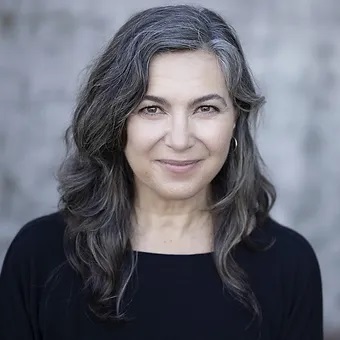
Along with this comes the restoration of the indigenous people's way of life, heavily dependent on those fish. My guest today is Amy Bowers Cordales, who recently published the Water Remembers My Indigenous Families Fight to Save a River and a Way of Life.
She is a mother, fisherwoman, attorney, executive director of Ridge to Riffles, and a member of the Yurok Nation and its former General Council.
And she is a 2024 laureate of the UN's highest environmental honor, Champions of the Earth.
Amy Bowers Cordales, welcome to Sustainability Now.
[00:01:47] Speaker A: Kwenikoi, good morning. As we say in Yurok country, thank you for having me.
[00:01:52] Speaker B: Why don't we begin with a summary of your book, the Water Remembers? What's it about and why did you write it?
[00:01:58] Speaker A: The Water Remembers is an intergenerational memoir about my family's tenure on the Klamath and our fight to preserve our way of life and to protect the Klamath River. And I wrote it because, as many folks know, on the Klamath, we are engaged in the world's largest river restoration project in history.
And that is extremely important for this moment in time as we face a political and ecological crisis, which are definitely interrelated.
So, one, I wanted folks to know that here on the Klamath in Southern Oregon, Northern California, we have worked together for decades to get to a very historic win for nature, for indigenous peoples, and also for business.
And so we don't have to, as humans, accept this trajectory of moving to Mars and abandoning the planet because it can no longer sustain life, we can choose a different outcome. So that was one, one purpose. But also, and equally as important is I wanted the world to understand the role of the indigenous peoples in that movement and how our tenure, our beliefs, our world value, our ancient rights, our leadership, our dedication to place, our relationship to place, and our Understanding about our responsibilities to nature and place and to our Creator informed this historic victory.
And, you know, I'm very blessed to be from a family that has been really active in that struggle since the beginning of time, really.
And not just the struggle, but also in the very beautiful, deep relationship of living on the river and having a fishing way of life. And so I felt really privileged to be a part of that family, and I wanted. And so I grounded the story in my family experience because that's what I had agency to write with.
And also, there are so many indigenous families on the Klamath who have a similar story. And so I, you know, I really want to honor that and uplift that while acknowledging, like, I wrote it for all of those reasons. And I wrote it based on my experience because that was, you know, what I've lived and what I'm familiar with.
[00:04:50] Speaker B: Well, let me call it Anglo civilization. Anglo civilization looks at rivers in utilitarian terms, largely right, as sources of fish, as for power, for water, for agriculture.
There was a time, of course, in Germany, I guess, when the Romantics tried to reify rivers, but.
But none of them ever quite put together the river with the creation story. And the Klamath plays an important role in the Yurok creation story. And I wonder if you'd tell us about that.
[00:05:25] Speaker A: Thank you. And I appreciate that question at the beginning of the interview, because so much of the creation story informs what has happened with humanity and on Earth from the Yurok Project perspective. And I started the book with the creation story for that purpose because it grounds us in the Yurok worldview of sort of why the Earth was created and then the role of the humans, and then how we're all supposed to live together in balance.
So the creation story, and it's. It's so beautiful and powerful. And when I ever. I think about it, I sort of close my eyes and envision all these shapeless, formless spirits in the universe floating around. And they started to feel lonely.
And so they found the Creator and told the Creator they were lonely. And the Creator thought about it and then said, okay, I'll make this place for you, and started forming the core of the Earth first.
And then, you know, kind of rose up with the land and then made the water so the Klamath and the Pacific Ocean, and then made the trees and the plants and the roots and the berries and then the animals and then made the humans last.
The humans were, you know, my ancestors, and the Creator gave the humans specific instructions about what to do on Earth. And Said, if you live in balance, you will never want for anything. And what's cool is that's the language that's been passed down. You will never want for anything. And that's what I wrote in the book.
But you have to take care of it. So you have to live in balance, never taking more than what you need, and you also have to steward it. So we as Yurok people developed law, religion, natural resource management practices that were to implement these instructions. And then, of course, as a nation, you know, the Yurok is a nation, we had inherent sovereignty, which means the ability to make laws and be governed by them, to implement an enforce those instructions. And there's really sort of a couple important themes that come out of that creation story. You know, one is that humans are part of nature, and our role in nature is to steward. It is like, we can harvest things so we can take. We can, you know, catch the salmon. We can use redwoods for our homes and our canoes, we can harvest acorns and other first foods. But we do it in a way that allows for the whole, whole system to remain in balance and for the individual little creatures to regenerate so you're not harming. And then what's cool, too, is like, the Creator was like, well, and I'll. I'll give you signs that, you know, you're living in balance. And so, like in. In Yurok, the way that we accumulate wealth is through sort of prized things from the earth. Eagle feathers. Dentalium is this shell that used to be our money. It's a long string shell. So if you were living a good life, you would get these signs from the Creator. Like, you would get an eagle feather, you would find mordantalium. You would always have, you know, enough first food, salmon and fish and things like that. And I included stories in the second part of the book that speaks to our aboriginal lifestyle that explained how that played out. So, like, there's the story of my fourth great grandmother, Susie Brooks, and my great grand Geneva mats going down to the mouth of the river to the beach, and they were gathering, and Susie Brooks would sing this song and fish would literally jump out of the water onto the shore so that she could, you know, put them in her bird and basket and then take it home and feed her family.
And I wanted to share that with the world because it just represents those instructions. You know, she was living a good life, living in balance.
And so the Creator and sort of the universe worked with her to make sure she had what she needed and what a Beautiful way to live. Like, think about if we were all living that way now, right? Like, if you, you know, went out into the forest or the ocean and. And you knew that you needed to fish, like, take away grocery stores. Completely take away grocery stores. You're completely dependent on the natural world to provide for your food. And then there it is, just presents itself. So it's really this, like, harmonious way of. Of living. And I wanted to share with people that that type of life happened here. And it wasn't that long ago. Right? I mean, really, like, we still try to live that way. And, of course, the balance has been disrupted, so it's not that way anymore. But they were living as early as, like, you know, the late, I guess, 1800s. So that's not that long ago.
So that's. And it's like, everything has its place, everything has its role, and you have to deeply respect that. The. The other piece that comes out of the creation story, and this goes back to the ideas of these spirits that were alone in the universe. So the spirits became many things. But the thing I wanted to highlight is, and I talk about this a lot in the book, which is Oregon, and A. Regis was one of these spirits who wanted to be together. And so the creator said, after the world was created, you can be immortal, you can live forever, but you have to have a job. And I want your job to be to tell the salmon when to come into the Klamath river and to also watch over the place and to be a protector of the people. And so Aragos agreed, and she became a huge, beautiful rock. Rock at the mouth of the Klamath river in the shape of a woman with a baby basket on her back. And her job is to do just that. And so she got to be, you know, on Earth in this place where she's no longer lonely and be immortal, but she has these jobs and these responsibilities.
And there's a myth that there were nine other spirits that took on the shape of rocks. But why that's important is because it speaks to the Yurok worldview about how everything in the natural world has a spirit and is alive. The river is alive. The rocks are alive, the trees are alive, you know, and I could go on and on about even the redwoods and what their role is, but everything has a spirit. And so when your worldview accepts that everything is alive and has some level of consciousness, some level of feeling, and everything has a role in keeping the whole world in balance, then how you treat it becomes much different than how European or what is the right phrase for that? You called it. What did you call it? Anglo, an angle.
[00:12:59] Speaker B: Ontology is the word that, okay, philosophers would use.
[00:13:03] Speaker A: There you go. Ontology. Okay, I love that. I'm learning new words too. But. But it becomes very different, right, because you don't just see it as a resource. Instead you see it a spirit that has a specific role on earth that if you take too much, and it's not that you can't use a tree or kill a fish, like, but if you take too much and annihilate it, then that role is gone and then the earth starts falling apart. So it just develops this deep respect for it.
[00:13:32] Speaker B: I mean, is that the source of the. The notion that. That everything is family.
[00:13:37] Speaker A: Yeah.
[00:13:37] Speaker B: And tribe. I mean, I haven't heard.
[00:13:39] Speaker A: Well said.
[00:13:40] Speaker B: I haven't heard the, you know, the argument, the notion of the spirits, which I presume were somehow connected to each other, being infused into everything.
Because I've always wondered about, you know, how do, do, do. I, raised in a, you know, European society which is highly individualized and focused on.
[00:14:00] Speaker A: Right.
[00:14:00] Speaker B: Self interest and the nuclear family, come to regard other things as being part of that sort of familial relationship. I mean, that's a really difficult thing to. To, you know, wrap. Wrap my mind around. So that helps a lot.
[00:14:17] Speaker A: Well, thank you. I appreciate the thing, the opportunity to explore it. The other piece of it, too, is leaving the ego behind and sort of getting out of yourself and being able to tap into this deeper consciousness where you can connect with these other spirits who are here.
And then when you all are working together symbiotically supporting one another, then everybody gets stronger.
And think about it like that's how an ecosystem works. And even just think about the role of the salmon. So the salmon do so much, but in this context, like, you know, the life cycle of the salmon is they're born in their home streams and then they migrate out into the ocean. They eat, and then they come back in as adults, like three to five years later. They feed the people, right? They feed the bears. And then when they get back to their home waters, their body, you know, they spawn and they die. And then their bodies and the nutrients in the riverbed become food for the riparian areas of the creek or wherever they were born. And so in that way, they're supporting all those different spirits and all that ecosystem to work together.
Right. And without the salmon, then we don't have food, the bears don't have food, and the river itself doesn't have food. And so we, as the humans, though, can tap into that whole cycle by acknowledging, one, that the salmon have a really important role in our survival or the planet's survival. But then, two, if you take that role out, then you're actually harming yourself because then you don't have food. And I think if you. If you understand that reliance and understand that I am not able to just sustain on my own little ego, I have to go beyond and deeply respect these other things that I'm reliant upon, then that helps everybody get stronger.
[00:16:16] Speaker B: You're listening to Sustainability now interview with Amy Bowers Cordalis, who recently published the Watery My Indigenous Family's Fight to Save a River and a Way of Life. Why don't you tell us a little bit about the geography and topography of the Klamath and its relationship in particular to your ancestral lands and the reservation and, you know, and the history of the treaties and the breaking of the treaties. I mean, that. That to me, it seems like a really important historical, social context for all of this.
[00:16:46] Speaker A: Yeah. Thank you. So the Klamath Basin is remarkable.
It is a large basin that straddles northern California and Southern Oregon. My village of Requoi is right at the mouth of the river on the north side of the R.
That's in what is now known as the north coast of California. The Requoi in the mouth of the river is about 50 miles south of the Oregon California border.
And the Pacific Ocean is wild and raging. And we have whales and sea lions and all kinds of birds and abalone and crab. I mean, just everything. It's so alive. And then you go into the estuary, and that's a place, you know, where salt water and freshwater merge. And there's this very powerful habitat there. And it's surrounded by redwoods. Well, it used to be. Historically, it's right in the middle of the Redwood National Park. And historically, there were redwoods all through the lower part of the river. You know, there was a lot of logging, and so most of those are gone now, but that's how it was. And of course, redwoods are some of the biggest trees in the whole world. Right. What they eat is actually fog. And so that whole area. Area has fog all of the time. And fog plays an important role in history. Ironically, it protected us from a lot of the, like, Spanish boats there and some of even, like, the Russian explorer boats, because there was such dense fog. They couldn't. They couldn't pierce it, basically.
But also, it's redwood food, and so it helps those redwood trees to thrive. And so the lower part of the basin, which is really like the lower sort of, I would define it as 45, 50 miles of the river is just wet. You know, there's like different forms of water and all its various forms present almost all the time.
And the river is like deep and wide and big there. Very big. And then it kind of goes into central Northern California and it starts gaining elevation and it gets a little drier. You get into the Cascades, Siskiyou Mountains, and that's where it's more of a evergreen conifer forest environment. And that's also the Karuk country, the Shasta Indian Nation, the Modoc, they all have territories there. And then you cross what is now the Oregon, California border and you get into really a high desert. And that's where the tribes that are now known as the Klama tribes, that was their aboriginal territory. And it's actually, it's almost sort of mind blowing how beautiful it is pre development.
People have probably heard about Crater Lake, which is this beautiful lake at the top of a mountain. It's one of the deepest lakes in the world. And runoff from that mountain would go into the upper Klamath Basin area, go into wetlands. There was about 200,000 acres of wetlands, Upper Klamath Lake, Lower Klamath Lake. And then it all drained down into the Klamath mainstem and down the river.
And so it was just this beautiful, powerful place full of all kinds of different and unique environments, a multitude of really important species. And there were, you know, Indian tribes, Indian nations all throughout it. So that's, that's what it was, right? And it was this just deep, deep abundance. The Klamath used to have the third largest salmon runs in all of the lower continental U.S. so it just like this was salmon country, right?
And then, of course, things changed. So the history is that, you know, settlers didn't really get there until like the 1850s.ish. And that was pretty late for the rest of the country, in part because it was so rugged, because of that fog blanket, all those factors. There was a treaty that my ancestors negotiated. And I talk about this history in detail in the book, but my ancestors signed, and that was in 1851, and it reserved a reservation for us. It reserved what we call our aboriginal rights to hunt and fish and to water, our inherent sovereignty in a pretty large territory. But the state of California at the time was in the business of genocide, and there were price tags on the heads of Indian people. And so California lobbied Congress and the presidential Administration at the time and basically said, over our dead bodies are we going to allow you, the federal government, to reserve all these rights for these Indians when we are actively killing them, to remove them from the land and take the resources?
And so, instead of ratifying that treaty, it was instead hid in the bowels of the federal government for almost 70 years and never to be seen or talked about. Nonetheless, what the federal government deemed as the Indian problem persisted in California.
And what that meant was they, the federal government, had to do something. And so, at least on the lower part of the Klamath river, in Yurok country, and also on a tributary to the Klamath, which is the Trinity river, which is just adjacent to Yurok country on the lower part of the river, the federal government issued a series of executive orders that created the yurok reservation between 1855 and 1892, and also the Hoopah Reservation. And on that, it reserved land for us. Eventually, the boundaries of the Yurok Reservation were settled as a mile on either side of the river, from the mouth up 45 miles.
And we were supposed to be able to continue our fishing way of life. We were supposed to be able to continue to practice this, those instructions that the Creator gave us. We were supposed to be able to continue to exercise our sovereignty, our way of life. But that didn't happen. And so. Pause there. And I want to acknowledge, too, at the top of the basin, there was a treaty that the Klamath tribes entered into in the 1800s. And then, sadly, at the middle part of the river, the Karuk, the Shasta nations, and the Modoc got things really bad because there was a lot of gold in that area. And so they were basically, and it's hard to even talk about this, like, annihilated. And their people had to, like, spread out into these other areas just to survive. So they don't have, you know, reservation land in that middle part. So meanwhile, that's what's happening with the Indians. And sort of, once they dealt with the Indians, then they went in. And this sort of paved the way for the gold rush, right? And so there was all kinds of mining happening also. This was an area rich with timber, so there was logging happening. And then at the top of the basin, There was, in 1905, an authorization for a federal reclamation project, the Klamath Reclamation Project, which drained those 200,000 acres of wetlands, turned them into agricultural lands, drained the lower Klamath Lake completely, rerouted the piping for the whole river and destroyed those natural ecosystem functions in that balance that I was speaking about earlier.
And then the federal government entered into contracts for water deliveries with those farmers that came on and then diverted, started diverting significant amount of water out of the main. Out of that whole system in order to support agriculture.
So that's the history, and it's all in the book. And one of the reasons I felt so strongly about writing the book is that, you know, that history hasn't put together, been put together, or written from an Indigenous perspective. You know, and I should take that back to. I should asterisk that, to say that there are certainly, you know, academic books that write about that history.
I felt strongly about the way that the. That the water remembers was written in that I could have written an academic book. I could have written more of. And I've written a gazillion legal briefs that outline all this history.
But I wanted to. To write the book in a format that allowed people to come to the river with me, and I would just tell them a story. I would just say, here is what happened from our perspective, and say it and tell it in a way that is consistent with the Yurok storytelling, which is always grounded in narrative. It's always grounded in actual story that has humor and heartbreak and adventure. And so that. That's. That's how I tried to write the book, so that people were going through this history, sort of like feeling the genocide and. And feeling the loss, but then also feeling the, like, thrill of fishing under the dark of night, running from, you know, these people who are trying to get us, which were the state of California, and the thrill of, like, teasing them or not teasing them, but tricking them and getting out. So, you know, and I hope it's a story that, like, opens people's hearts so they can feel a little more vulnerable and then maybe puts them in a place of being able to relate to the story more, which I think is important because I'm not sure as a nation, we've done that with respect to the history of how this country has treated Indigenous peoples.
[00:26:39] Speaker B: You're listening to Sustainability now interview with Amy Bowers Cordales, who recently published the Watery My Indigenous Family's Fight to Save a River and a Way of Life. Okay. In your book, or at least in the Chronicle San Francisco Chronicle article, which is how I first found out about your work, it mentions that you had originally thought to become a singer.
Is that true?
[00:27:03] Speaker A: Yeah, it is.
[00:27:04] Speaker B: Yeah. But instead you went into law.
So I'm curious, you know, how did you get into into law? What has happened since then with Your. You know, with your career, it's been.
[00:27:15] Speaker A: A wild, fun ride. And I feel extremely privileged.
And I'll answer that question this way, which is, I have been really fortunate to continue my family's legacy of fighting for the river. And I had enough privilege to be able to do that with a law degree.
Education is not something that was accessible for my family. Yet they had tremendous victories, like a Supreme Court case win that confirmed the status of Yurok country and our fishing rights and our water rights, you know, and they did that without money, without education.
But they were deeply rich with culture and with their Yurok values and the power of prayer. And that was something that always guided our family. And so I also put that through the book the whole time. Because in each struggle, those core values of Yurok culture, of, you know, living our fishing way of life. And having a deep belief in the Creator that carried the day. But I felt really privileged because I had. I was able to access different tools.
And how that all came about was really through.
It's. It's hard to know where to start, but kind of going back to where we ended. The historical picture down at Yurok country, where the reservation is created. And by 1892, everything sort of settled legally, I would say. But then another act was passed, the General Allotment Act. That was also applied to the yurok reservation in 1892. And that opened up the reservation for non Indians to purchase surplus land. It also allotted tribal land to individual Indian families. And so my family got some of the land there. We have two different allotments, and other Indian families did. And then the remaining surplus, what they deemed surplus, was transferred and in legal and illegal ways to mostly timber companies.
But what the state claimed that did was completely terminate the Yurok Reservation. And they claimed that that act terminated the Yurok Reservation. And so the state had jurisdiction, and the federal government had no jurisdiction. And the tribes, including my family, my tribe had no fishing rights, no special water rights, no inherent sovereignty. And then it got worse. In 1933, the state of California passed a law claiming that it had jurisdiction to do so. That prohibited all Yurok people from fishing on the Lower Klamath River. And it's been widely acknowledged that for Yurok, our river and our fishing way of life and fish themselves are as important to us as the air we breathe. And so to pass an act that says you can't fish is basically another way of. It's like another way of saying you can legally kill these people. That's what it. That's how Deeply intertwined. Everything is. And so the family fought. The family fought and for. Well, and that legal battle ended in 1975 with the Supreme Court case Mats versus Arnett, which said, no, the General Allotment act didn't terminate the Yurok reservation.
It's still Indian country. The Yurok tribe still jurisdiction over this land and fishing and water rights in state of California. You were wrong. There was a whole amazing story behind all of that. You know, my Uncle Ray was really one of our freedom fighters. He was arrested 19 times just for fishing because he believed so strongly and the family believed so strongly they had these Indian rights. And so I, you know, I tell the story in the second part of the book about that. And so that was.
[00:31:11] Speaker B: Was.
[00:31:11] Speaker A: That was decided in 1973. And then things got worse with the salmon wars right after that, where the federal government said, oh, well, you're not regulating your own fishery, Yurok, even though we were, according to those initial instructions from the Creator, never taking more than you need. But the federal government didn't acknowledge that. And so they put a full moratorium on all year rock fishing again. And so we went to war. You know, it was dangerous. They sent out federal marshals to enforce it with full riot gear. And there's a really powerful story of how that war ended, using Indian way. And my grandma and great grandmother really stepping up into that moment and calling in the birds to help them, which I describe in great detail in the book. And it freaked out the goon squad, as we call them. And they left the reservation. And then shortly after that, I was born. And I really always loved the river. I had this deep, deep love for the river. And I loved fishing. And I grew up close to the river. I, you know, I wasn't raised in Reckway, but we were always there. And so I just had this deep love for it. And we had our. Our sort of like our fishing rights established by the time, like by the 1980s, 1990s. But then 2002 happened, and I was home working for tribal fisheries. I was in college then, but it was a summer internship. And the largest fish kill in American history happens on the Yurok reservation on the Klamath River.
[00:32:51] Speaker B: Can you say a few words about why that happened?
[00:32:53] Speaker A: Yes. Yeah. So 70,000 adult salmon died because of bad water management. And I did a lot of research around the economics of it, the politics of it, the sort of administrative record, the law around the fish kill. And. And I actually, I lived a lot of this too, just in my own work, why it happened Was because water was diverted to support agricultural deliveries at the very top of the basin. And also, the conditions created by the dams were so awful.
Just polluting the river, ruining the riverbed, raising water temperatures. So you put all that together. And then that year, there was a large chinook salmon run that returned, and it was a drought, so there wasn't any water in the water. And it was hot. It was super hot. Perfect storm. All those fish die. Well, so Dick Cheney had a big role in this. Where it was the Bush Cheney administration and the reclamation project irrigators were Republican, and so they diverted the water to get the votes. As a result, the fish died. And the fish kill had massive implications. It caught cost about 500 million in closed commercial fisheries for the, you know, following several years.
We look at it an Indian country on the river as an act of ecocide against our people because, again, we have such a deep relationship with the salmon that to kill them is to kill us. But here's what it also did, is it launched a whole new generation of indigenous peoples from the Klamath, including me, into the fight to save the river. River. And also it got the attention of our allies, you know, of other people who believe in healthy ecosystems. And. And the message really was from the river. Like, if you look at it as from a Yurok worldview, again, of, like, the river is alive. It was a message from the river to the humans. Like, whoa. Things are so out of balance that if you don't change the way you are interacting humans with the natural world, with this river, it's going to die. Like, the whole river would perish. And so it launched this undam, the Klamath movement. And that's really how I got involved. And I had this very profound moment, which I write about in the book, where I was. It was the fish kill, and the fish had been dying, and there were a lot of dead fish, and their bodies were floating down the river. They would get caught in eddies and kind of circle and then get shot out. And then they would start lining the banks of the river, and their bodies were mutilated and rotten from a fish disease that had killed them called ick that basically spreads in all those kinds of bad conditions I was talking about.
It smelled like a war zone. I mean, think of the stench of 70,000 salmon bodies rotting along the riverbank. Think. And I just felt my great grandmother, you know, again, Geneva Matz, just kind of move through me and tell me, like, it's your turn to fight. And then my next thought Was, I'm gonna go to law school to try to prevent this kind of thing from ever happening again.
I don't know why it was law. Sometimes I wish it wasn't. I don't. I have no idea. But that was what it was. And I naively thought, oh, well, if I'm a lawyer, like, I could prevent this from ever happening again because the law is such a powerful tool in many ways. It has been, for sure. But I will never know why. I don't know why it wasn't, like, go write all these songs about this and go tour the world with these songs. But that's what it wasn't that. It was go be a lawyer.
[00:36:43] Speaker B: So what was your specific role, then, in the process of getting the dams removed?
[00:36:50] Speaker A: Yeah, so I had the honor and pleasure of. Of representing the Yurok tribe in all things Klamath River. For a while. I was the tribe's general counsel, and so I ran all the tribe's legal affairs. And then later on, in about 2020, the river was extremely sick. The dam removal deal was on edge. It looked like it could collapse or terminate. There was a companion agreement to the dam removal deal that had terminated. And so things were really bad. And at that point, I worked with the Yurok Council, and we decided that we would transition my role to focus exclusively on Klamath river matters and get dam removal done and try to figure out another way to address the benefits that were lost in the termination of the other agreement. And that led to the formation of the Ridges to Riffles Indigenous Conservation Group, which I co founded with a brilliant career Baruch strategist, Molly Myers. And so now I continue under Ridges to Riffles to represent the tribe. And we do it pro bono. And it's. So much has changed, which I can get to there, which speaks to the work that we're doing with Ridges to Riffles. And this should be clear. And I think this is a lesson learned from Klamath, which is there were thousands of champions of Klamath dam removal. There wasn't just one.
And without all of those people contributing in big and small ways for two decades, we wouldn't have got to plan a dam removal, you know, So I was one of a team of lawyers, and I think the thing that I helped provide was my.
I focused my legal education and then my work before I came home at the Native American Rights Fund on really understanding federal Indian law and the role of treaties and reserved rights and really understanding them. And they were so powerful in the context of climate dam removal because those rights, the federally reserved rights, are supreme rights. They are based in, you know, the, the federal constitution, which says, like, federal rights are supreme over state rights rights.
And also we had all this great case law, you know, based on Matt versus Arnett, my family's cases, that basically said we have a right to fish. And with that right to fish, there's a corresponding duty on the federal government to make sure that there are fish in the river to the extent they can control that. And if there aren't, like if they take an action that harms the fish, AKA pulling out all that water, for example, or reauthorizing a dam would be another one.
If those actions harm the tribal fishing right, that's against the law. And so there was a regulatory proceeding to relicense the Klamath dams. And that was sort of the. Well, there was a lot there before that. But in terms of my role in that regulatory proceeding, I worked with a team of lawyers and we were able to put together arguments of how the tribal rights sort of work together with the environmental laws and also the federal power laws. Right. The Federal Power act has this really important section, section 8, that basically says if you have a dam on a waterway with, and I never say this word, right. An andronomous fish, you know, fish that go andronimous.
[00:40:28] Speaker B: Yeah, you.
[00:40:29] Speaker A: Yeah, okay, maybe I got it right. But after all these years, you have to have fish ladders. And there were no fish ladders in the Klamath on those dams yet. They were the third largest salmon producing river historically in the states. So long story short, we leveraged all those and we won on almost every account. And that helped get us to a place where there were settlement negotiations.
And then that led to an economic analysis that determined it was cheaper to remove the dams than to install fish ladders to comply with the tribal rights, the environmental rights, the federal power acts.
So that's how we got it. I do want to add, you know, another thing that I think is. Was really important for my role is just to help uplift all of the tribal voices. The federal government has very specific, important, what we call tribal consultation policies, where anytime the feds are doing something that implicates tribal rights, they're supposed to consult with them, which means, you know, talking and understanding what the harm is or how the project implicates the tribal rights. And so I really tried to lean into those consultation policies and enforce those and then put the tribal people in front so that those regulators, so the adjudicators could see the people could hear the people and you know, those are the voices that saved the day, not mine. I was just a translator. And then I now have the pleasure of serving as the Yurok tribe board member to the dam removal entity. And so it's fantastic and wonderful and hard work.
[00:42:10] Speaker B: You're listening to Sustainability now interview with Amy Bowers Cordales, who recently published the Watery My Indigenous Family's Fight to Save a River and a Way of Life.
Did you want to say anything about Ridges to Riffles?
[00:42:23] Speaker A: I'd love to. Thank you. So we are an indigenous led conservation nonprofit and it's all indigenous at this point.
And our role in the basin is to help increase tribal capacity to manage and protect cultural natural resources.
And I continue to do my legal work for Yurok through that. But we also help facilitate inter tribal relationships and restoring relationships to land and water and those cultural natural resources. And one of the ways we're doing that is through a multimillion dollar restoration project within the former Klamath hydroelectric area. So we're basically helping to restore all of the land that was inundated by the reservoirs behind the dams. And my brother actually works on this and he calls it that he's building salmon playgrounds so they, you know, they're rebuilding habitat.
And RR's role is to facilitate this inter tribal advisory committee that basically puts the tribes with the historical ties to these lands and the traditional knowledge about how everything worked together in balance pre development in the management role of this restoration. So the engineer and you know, the, all the various folks, usually how it works, they're driving it, they're saying here's what this system needs, here's how we're going to do it. And instead now we're putting the tribal people with that historical knowledge, those that, and also that different worldview in the driver's seat. And those folks, the engineers, you know, the scientists, they're reporting to them to say, here's a project idea. What do you think? Think? And then they sort of marry all of that knowledge between, you know, the modern science, modern engineering with the traditional knowledge and the values. And that's where we are seeing phenomenal outcomes. So it's a really powerful way and, and that's a piece of the work that R2R is doing.
[00:44:39] Speaker B: Now let me shift to something entirely different. I'm interested in, in here having you talk about how you actually, actually fish for salmon. You know, I mean the, the way that us folks outside imagine it is right, is with rod and reel kind of stuff. But, but that's not what you do. So talk a little bit about that.
[00:45:00] Speaker A: Well, we do fish that way. And right now it's steelhead season, and those are really fun to catch on rod and reel. And we will fish for salmon, rod and reel. But I would say when we're fishing for subsistence, and I think it's important to, to share that you and many other indigenous families on the Klamath, we still live a subsistence based way of life. And so that means, like when we, when the salmon come home, the largest run right now is the fall chinook, which come home in August and September. So we primarily fish those consistent with that value of, like, regeneration. But what that means is, you know, we're catching salmon to a lot of times it's smoked and then canned, and then we can eat that for the whole year. A lot of times we'll fillet it and then vacuum seal it and freeze that for the whole year. Also. Not everyone is able to fish anymore. And so, you know, like, when my family goes out, we're fishing for several, several different families. And so we'll harvest that and then the other families will come and help, help, you know, like smoke it or can it or how process it or we'll just give it to them fresh and then they take it home. And a story of that is this year salmon came home 30% more than they had last year. And salmon still, they've got a long road to recovery. But this year there were a couple fun bumps in, like, where we had a lot of salmon. It was the first time, I don't know, probably in at least 12 years that we had had a big run and it was so fun. We had a blast.
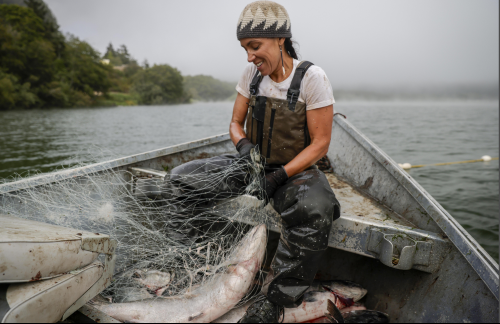
But one particular catch we brought home and people from all over Southern Oregon and Northern California came and got some and then took it home. Right. And are probably, you know, still enjoying it now. And I love sharing that story because it just speaks to how the abundance of the Klamath spreads and takes care of people all over. Right. So but to answer your question of how we fish, so we fish with gifts, gill nets. And the tribal fishery is heavily regulated by the tribal government. So there's limitations on when you can fish, even where you can fish, and how you can fish. So by tribal government regulation, your nets can only be up to about 100ft long. And Gill netting is quite an active experience. I have the scars to prove it.
The idea is that you have a gill net, so think 100ft long and the depth can range sometimes they're 40, 30, you know, 20, 10 sometimes meshes deep. And you can pick the size of the. The webbing. So the webbing is like a hole that the fish swim through.
And when they swim through, eventually it gets too tight on them, the. The webbing. So the circle they fly, they go through, gets too tight, and they can't get out. And so then they. They flap around and they try to get out. And then their gills always get caught in those nets, and then they just can't get out. And that's why they call it a gill net, because eventually, you know, the gills, which are.
There's like a long or there's a flap there kind of at the bottom of their cheeks that is pretty strong. And in any event, they get caught there, and then they get wrapped up. And when this happens. So on the top of the net, there's what we call called a cork line. And the corks are these Styrofoam circular.
I don't know how big they are, maybe 4 or 5 inches that sit on a rope. And when a fish hits that cork closest to where the fish is caught is pulled down into the water. And that's how we know we got a fish on. And so then we go out to the net, and you check the net by, like, you know, pulling up the actual net net. And eventually, as you go down the net, we call it checking the net, you can see where the fish is. And so then you pull it up, and it's quite an effort to pull it up out of the water and into your boat. And sometimes the fish is still alive. And so we'll fight. And then you got to untangle it, which is sort of like, there's an art to that. There really is an art. And I talk about in this. In the book, and I describe this in great detail.
And it's really like a love letter to my dad, because my dad is. Is one of the best fishermen of his generation. And I got to learn to fish with him beginning from a very, very young age. And he's an expert, you know, and so he can just look at the fish and know exactly where to, like, pull. And he always says, start with the heads and the tails. Get those unwinded first, and then figure the rest out. And so it's just. So he. So I tried to write about sort of this art in the book because he. He does make it an art anyways. And then once the fish is untangled, we always say a prayer to thank the fish for giving its life for us. And that. That was one of the first things that my dad taught me. And so we always say that, and sometimes it's just in your head, but you always thank the fish and then you go and you take care of it. But that's how. How we fish. It's a lot of fun.
[00:50:21] Speaker B: We're almost out of time. And I just wanted to ask maybe as a last question, you know, how is the current administration in Washington affecting or going to affect your situation on the Klamath?
[00:50:35] Speaker A: Well, there are impacts. Some of them will be short term, some of them may be long term, depending on what happens.
Recently, the Trump administration issued new legal guidance for operation of the Klamath Reclamation Project that aims to essentially make it so that the Endangered Species act doesn't apply to the federal government's delivery of water under those water contracts. And sadly, what that could mean for the river is that we could be back into conditions like Those present in 2002 when the fish killed happened. Because.
And how do I describe this? Essentially what happens now is that on the Klamath, minimum in stream flows for coho salmon, which are endangered, are the only in stream legal requirement for the Klamath mainstem.
And so they provide really important sort of just minimum flows to make sure that the river's ecology can function and that fish have enough water to migrate upstream.
If this memo that the Trump administration issued comes into play, it would threaten to reduce the amount of water that could go down the river to such extent that you could have another ecological collapse. Collapse. Salmon could get stranded. You could dewater the Klamath depending on how the year is going. And so we are in a posture now where we're trying. Well, we are developing strategies to respond to that and also working closely, you know, once again with our allies that we developed and also trying to talk with AG about how do we make all of our lifeways sustainable.
You know, if, if the river is in a condition where it's going to collapse, if we're in a position where we're going to have massive fish kills, that's not sustainable. That's, you know, that's not helping any community, especially because the salmon now are going all the way back into Oregon into through the reclamation project. And, you know, so we're all salmon people now, and how do we make our lifeways sustainable? And that's really what we're. The question we're trying to ask our now as we respond to the Trump administration's attempts to really empower one community to the detriment of many other communities.
[00:53:08] Speaker B: And the environment well, on that note, thank you, Amy Bowers Cordales, for being my guest on Sustainability Now.
[00:53:15] Speaker A: It is an honor and a pleasure walk. Lau. Thank you.
[00:53:19] Speaker B: You're listening to Sustainability now interview with Amy Bowers Cordales, who recently published the Watery Media Members My Indigenous Family's Fight to Save a River and a Way of Life. She's a mother, fisherwoman, attorney, executive director of Ridges to Riffles, and member of the Yurok Nation and its former general Council. If you'd like to listen to previous shows, you can find
[email protected] Sustainability now, as well as Spotify, YouTube and Pocket Casts, among other podcast sites. So thanks for listening and thanks to all the staff and volunteers who make K SQUID your community radio station conversation and keep it going. And so until next every other Sunday, Sustainability Now.
[00:54:09] Speaker A: Temperate zones and tropic climbs and through currents and thriving seas and winds blow breathing trees, strong ozone, safe sunshine, good planets are hard to find. Yeah.