[00:00:08] Speaker A: Good planets are hard to find. Now Temperate zones and tropic climbs and run through currents and thriving seas.
Winds blowing through breathing trees and strong ozone, safe sunshine.
Good planets are hard to find.
[00:00:30] Speaker B: Yeah.
Hello, K SQUID listeners. It's every other Sunday again and you're listening to Sustainability Now, a bi weekly case Good radio show focused on environment, sustainability and social justice in the Monterey Bay region, California and the world. I'm your host, Ronnie Lipschitz. The world's cities are big and getting bigger depending on whom you ask. Right now, one half to two thirds of the world's population lives in cities and towns and that number is projected to grow to more than 80% by 2050.
Urban metabolisms are very resource intensive, require extensive infrastructures to operate and draw on large hinterlands to keep them going. Can cities be made sustainable?
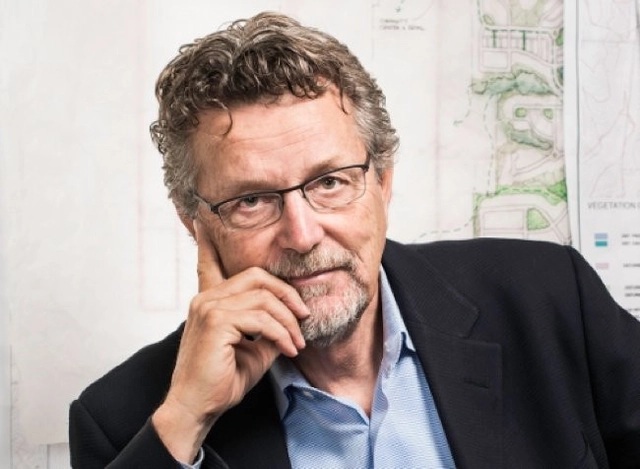
My guest today on Sustainability now is Peter Calthorpe, urban designer and architect who over the past 35 plus years has advanced a global trend towards sustainable communities, New Urbanism and Transit Oriented Development.
By my count, since 1986 he's published at least 10 books on sustainable communities. His most recent publications are Ending Global Urban Standards for Sustainable and Resilient Development Done for the World bank and grand boulevards and the AB 2011 revolution reinventing the Strip to Solve California's Housing Crisis.
Peter Calthorpe, welcome to Sustainability Now.
[00:01:59] Speaker A: Thank you.
Now and then and forever and forever.
[00:02:04] Speaker B: Yeah, if we can just figure out what it means, right? Yeah. Why don't we, why don't we start by having you give us a brief biography, you know, who you are, how you got into architecture, what kinds of things you've done, you know, you can range freely. There are no limits here.
[00:02:19] Speaker A: Well, I, you know, grew up, well, I grew up all over the place, but as a teenager I grew up in Palo Alto. So I got hit heavily with the hippie world, which to me was a really powerful and positive phenomena. And you know, at that point everything was up for grabs. We could basically reinvent anything, whether it was politics or ecology or sexuality or.
Everything was ready for a makeover at that point. And I was engaged with a group that had started an alternative high school and also a really great Quaker elementary middle school that really wanted to test the limits of what you could do. And it, it became a bit of a hippie commune up there on Skyline Boulevard.
And I taught mathematics and design and that's, you know, where I first met Bucky Fuller and a few, and Stuart Brand and a few people like that.
And so there was a, a dimension of that Whole set of rethinking that had to do with the built environment. And it was, how are we going to live on the land? How are we going to live with each other? Those are kind of the two basic questions that we have to answer all the time. And so I. I began experimenting and being part of a. A movement, as it were.
From there I went on to. I decided to start designing building houses myself, which I did for a number of years, and. And experimented with passive solar. Got really interested in how buildings could be shaped to basically work with their climate and demand less of the environment and also be beautiful at the same time. So that was a whole movement, I don't know if you remember it, called passive solar. There were conferences and whatnot.
[00:04:18] Speaker B: There was that book that I remember, and.
[00:04:20] Speaker A: And Ed Masseria, a good friend of mine, wrote a book about it. But there were several conferences where we would all get together and talk about how to do it and what the, you know, what the thermal calculations look like and all sorts of crazy stuff.
[00:04:36] Speaker B: Yeah.
[00:04:36] Speaker A: And then from there I got to be friends with Sim Vanderen, who, of course, he and I went on to write the book Sustainable Communities.
But along the way, I got detoured and was told I needed to study architecture. So I went to Yale Graduate School, where we were just talking about.
There I met a lot of really pathetic people like Philip Johnson and all the modernists who cared more about what a building looked like than how it behaved in the urban environment or in. Or in the larger ecological environment.
And there were one or two really great people there. We were just talking about Charles Moore, who began to break the ice in terms of thinking about buildings in the way they shaped shared space as opposed to in the way they looked on a magazine cover.
So Kresge College, we were just talking about, was really about shaping a public winding hilltop pathway where everybody could run into each other and hang out with each other and where confluence was at the. Was really the point of the built environment.
So that was a good stopover. I got to know a lot of interesting people.
A real mentor at that point was Vincent Scully, the famous architectural historian, who was also ready to break out of the modernist, you know, lockstep of we have to reinvent the way buildings look.
And of course, it was a brutalist phase in architecture. It was horrible. Had nothing to do with passive solar or anything I was interested in. So I left.
Actually, what happened was I got a call from Sim Vanderin, who'd just been made the state architect by Jerry Brown and He said, peter, you know, I'm supposed to design a bunch of state office buildings and redo the capital area plan.
And by the way, I'm starting a new department in the state called the Office of Appropriate Technology.
And so Sim had taken his whole basket of stuff from the Integral Urban House to the Fairlongs Institute and transferred it up there. Jerry was, of course, totally into all this stuff. Stuart Brand was, you know, in terms of a thread that runs through it all for me was Stuart. He was always there, you know, at the beginning of the counterculture and the Trips festival and all of it, you know, from light shows to inventing the first online email system.
[00:07:19] Speaker B: Bulletin board. Right?
[00:07:20] Speaker A: Yeah, it was the.
[00:07:21] Speaker B: The. Well, was it the.
[00:07:22] Speaker A: Well, it was called. Well, yeah. So it's. And then Steward veered more really intensely into digital technology and was really at the source of a lot of that. So he was a real leader. And I'm just saying that because he's published a new book and called Maintenance, which I should plug for him because it's just a beautiful piece of work, like everything he does.
Anyway, so Stuart was there as an impresario for Jerry, bringing in the best and the brightest from all over the world. We had E.F. schumacher come by, and of course, Bucky was in and out, and there was just Hassan Fathei. Just an amazing array of really big thinkers would come through. And Jerry, being very Socratic and in his Jesuit way, would bring people together and have amazing debates. You know, actually his criteria, anybody who joined his cabinet had to read small is beautiful.
I was like, okay, this is the rite of passage, and we're gonna be on the same page. Well, that opened a million doors for me because first of all, Sim wanted. Sim was so busy, he couldn't actually execute anything. He just had to keep thinking stuff up.
So the Bateson Building, which was a quarter million square foot office building, is actually the large.
The first large building I got to help design.
It sits there today. It's really quite a beautiful piece of work.
[00:08:57] Speaker B: This is. This is in Sacramento, near the.
[00:08:59] Speaker A: In downtown. So what it. What was going on was Reagan had been governor before, and he was leasing really crappy stucco office buildings in the suburbs as state office buildings. And Jerry and Sim wanted to rethink how the state would own and operate buildings.
So Jerry asked me to kind of lead the design. There was a great team of designers on it, and we did a, you know, a quarter million square feet. It's a. It's a full city block.
And instead of. We kind of rethought buildings at that scale. It was all natural, not all natural because of course, something of that scale needed backup systems. But it was naturally daylit. It had operable windows, it had operable shades so that instead of glass covered with, you know, reflective material, you basically, on an east side or a west side, you had a big canvas shade coming down outside the building to shade it. There was the courtyard, had a series of south facing monitors that had louvers that allowed the sun in in the winter and kept it out in the summer. So it was a true buffer space and a source of kind of social coherence. We hid the elevators and made the stairways, these grand things looping through the courtyard so that everybody could see everybody else coming and going and kind of create the activity, you know, and there were so many beautiful things that happened the moment you say the building should be energy efficient.
So compared to the buildings next door that Reagan had built, these two glass office towers, the Bateson building consumed just 20% of the energy.
And it used its thermal mass in the concrete, just like in a big old adobe building in New Mexico. Take in the cool night air, flush the building out, pre cool it.
Big thermal battery. The building became a thermal battery and high ceilings because of course that's how you get natural light into buildings. So it was just a huge number of experiments and they all worked. And then in more interesting yet in terms of long term sustainability, that building became the model for what's called Title 24, which is the energy standards that Jerry put into place for the state of California to reduce energy in buildings, which is the single, had the single largest impact on our California's per capita carbon emission.
We're about half of what the rest of the country produces. And a lot of it has to do with energy efficiency in buildings that were started. I mean this was 40 years ago.
And all that was exciting. We got to work with computer models that showed how these buildings could work.
And the models became part of the law. You could do an exotic design that was, you created a performance analysis for, or you could do the prescriptive, just make sure everything's well insulated and the rest of that. But it was really the beginning of energy efficiency in buildings. Meanwhile, the capital area, Sacramento, if you haven't spent time there, actually is a beautiful old gridded downtown with really big London plane trees shading, you know, sidewalks lined by beautiful bungalow porches and corner stores and everything good about an old traditional urban place.
And of course, the Reagan administration had planned a, a complete Demolition of the center of the city and build super blocks with towers, which was the classic modernist approach to urban design.
So we set about redoing that. And that was, I worked with John Cricken from SOM on that.
And we preserved the historic grid, we preserved all the street trees, we preserved historic housing that was right in the middle of the city.
We allowed for more housing and more mixed use.
And of course we added a light rail line so that it became a train. One of the first TOD experiments, I think, at least for me, it's when the idea actually got grounded, then the next thing that happened. But all these things are very relevant. And then Sim was saying, yeah, but we've got to really look at how the city itself interacts with nature.
And there was all sorts of standards around recycling and, and water conservation and water reuse and things like that. But I remember one of the most kind of radical ideas that he had was, well, we have beetle infestations up in the Sierras and a lot of dead wood up there.
We can haul the deadwood down, chip it into pieces and put it into a wood chip gasifier which turns the wood into flammable gas and then run the whole capital area on biomass energy and waste heat. Because there was already a, like a university system, a central power plant for the center of the city, CO generation in this case. So that was, I mean, we got to experiment with everything.
So that was a real launching pad.
And then in the second administration, Sim and I took off from Sacramento and started our own practice where we designed, you know, energy efficient buildings and systems and started this thing called the Fairlawns Institute, which became the classic kind of place you can do it all. We had passive solar buildings and greenhouses and organic farms and barn building and Clivis Moultrim composting, toilets and everything you could think of in one place and you know, shared dining rooms and all the rest of that. So that was, you know, those were kind of foundational.
[00:15:20] Speaker B: You're listening to Sustainability now. I'm your host Ronnie Lipschitz, and my guest today is Peter Calthorpe, architect, urban designer and a central figure in the movement to develop sustainable communities over the past five decades.
[00:15:33] Speaker A: Moving forward from there, I got more and more interested in the larger scale, not one building at a time. And quite frankly, the idea of building autonomous communities out in the woods didn't seem like a systemic solution to me.
So I got more and more interested in this idea of urbanism and, you know, how we shape communities. And of course the obvious target was suburban sprawl, which of course is the antithesis of everything you want to believe in.
So coming up with alternatives to sprawl was the next agenda item.
And Andres Duaney and Liz Plater Zeiberg had been at Yale when I was there and I knew them briefly but not directly.
So Sim organized something called the Westerbeck Charrette, where he invited all of his, you know, all the people that were really thinking differently about the built environment. And that's where the book Sustainable Communities came from. Had people like Paul Hawken and, and Claire Cooper Marcus and just an amazing array of people that were willing to think what the shape of the next city should be. And that was the genesis of that book, which then got a lot of attention anyway, so I took off on the community, the, the urban design side of this, which I had grounded in Sacramento.
And with Liz and Andreas and a few other people, we founded this thing called the Congress for New Urbanism.
If you took Sim and McHarg's vision of how the city sits in nature instead of against nature.
And McCarg I'm rereading right now, and he's just an incredible thinker, but all that kind of resulted in the idea of a kind of urban growth boundary. And what happened inside the boundary wasn't so relevant, especially to McCarg. You know, what is the shape of the communities? He, he felt like, well, as long as you did a good job of preserving the critical ecological features of an area and the watershed and, and habitat and all the rest of that, then have at it with the rest of it. And so the idea of New Urbanism was to combine that green attitude at a large scale with a historic urbanism, a rediscovery of urbanism that really supported the pedestrian and human scale communities.
One of the inspirations for that was Leon Krier from Europe who had been doing these alternative drawings of, well, what if we just rediscovered everything that was great about pre modern European city center and, or village town fabric?
And to a certain degree, Charles Moore had done a bit of that as well. So there was this idea that you could bring it all together.
And the charter for New Urbanism operated at three scales. The regional scale, the town scale, the city and the block. So it was meant to be a kind of telescoping approach to the thing.
And I got very involved with the regional scale planning which led me to, I think, the first big TOD plan for Portland.
It was romantically called lootrac, the Land Use Transportation Air Quality Study
[00:19:06] Speaker B: for the benefit of our Listeners, TOD is Transit Oriented Development, right?
[00:19:11] Speaker A: So this great group up in Oregon who had helped facilitate and then protect the urban growth boundary legislation that they had put in place was up in arms for good reason, which is that the federal and state traffic engineers had decided Portland needed a beltway freeway around the edge that went right out into a beautiful protected agricultural valley, which of course, you know, if you put a freeway through it, you'll have sprawl in it before too long.
So they wanted an alternative to that. They wanted to stop that.
And I got together with them and they said, well, actually I said, why don't we create an alternative plan to show how the city could grow without violating the urban growth boundary and without building another goddamn freeway, and take the money that was going to be spent on the freeway and spend it on light rail instead, which Moynihan, the great Senator Moynihan, had put into the state legislation for spending gas tax money on transportation. So every jurisdiction, every MPO could decide how to spend the money hypothetically. Almost all of them decided just to build more roads, because that was the NIMBY attitude towards growth.
And the local jurisdictions all wanted those dollars for roads. So you didn't get a lot of people saying, no, no, no, we're going to build a light rail system instead of a freeway. But we did in Portland. That's the west side light rail line.
And in order to solve for the growth without violating the urban growth boundary, TODs were the obvious answer, which is, at each station you build higher density, mixed use and walkable.
And hence that was the first TOD master plan at that larger scale. I had played around with the idea at Berkeley as a design studio, theoretically. As a matter of fact, that design studio used what is now the Smart Train up in Marin Sonoma. It used an abandoned railroad right of way as a hypothetical light rail system, which then had little TOD nodes along it, which to a certain degree has all come true anyway. So that was the first big one. And then we were really off to the races because we not only had a paradigm for how to build a walkable neighborhood, what Liz and Andreas called the tnd, traditional neighborhood design, but we had the tod, which was a way of organizing growth at the regional scale that was environmentally sensitive.
All right, I'm going to leave the story there and come back because there are some very interesting next steps.
[00:22:05] Speaker B: The whole idea of sustainable communities, which is still, I think, you know, one that that is around is a, is a pretty thought provoking one because, I mean, cities are really complex systems Right. They, they rely on, on hinterlands and extensive infrastructures. And then of course there's the politics, right, which, which is, is always. Whether it's obstructionist or not, it's always really complicated.
So, I mean, where did this notion, you know, come from? I mean, you talked about, I guess, sort of European cities as a model, right. More walkability, more.
[00:22:46] Speaker A: I mean, closer, but also American, traditional American towns. Don't forget, before the post war period, we had magnificent urban centers. We had streetcar suburbs. It was tod before there was tod.
Growth happened out along the streetcars. The stations were walkable places. It wasn't unlike what Ebenezer Howard had envisioned at the turn of the 19th century in garden cities.
So we had a healthy fabric. We just destroyed it after World War II with massive investments in freeways and underwriting subdivisions through FHA and the GI Bill. I mean, we basically, you know, subsidized a form of growth that was really malignant.
And that's, that's how we got where we were. And we were all, all about trying to fix it. But my point of interrupting is that I don't think it was just about European precedents. We had a good set of precedents in our lap.
We had wonderful neighborhoods, actually. Sacramento, downtown Sacramento neighborhoods. Beautiful places, you know, completely mixed in terms of housing type and, and family type and things like that. So. Sorry to interrupt.
[00:24:11] Speaker B: No, that's okay. I mean, that's, that's fine. I mean, I mean, it, it sounds like the cause of all of this is essentially the car that, the access.
I mean, and that of course is connected to all kinds of other things.
Develop, urban development, economic growth, capital accumulation. I mean, it's not obviously just the car itself.
[00:24:32] Speaker A: Oil, Oil, oil and land.
[00:24:35] Speaker B: Right. Land.
Selling. Selling land.
And you know, as you said that I suppose the, the FHA and, and the GI Bill and, and so on and so forth. Right. I'm. I'm wondering, you know, in a sense, certainly in recent decades, what we've heard about is that technology is going to solve all of these problems, you know, with the notion of the smart city. The smart city that is essentially managed by intelligent computer programs. I guess that's what artificial intelligence will, will do. And there's a sense in which appropriate technology. You know, the whole movement was, was against that kind of reliance on technology, certainly high technology.
I mean, and then on the other hand, Stuart Brand was a great advocate. Right. Of digital technology.
[00:25:29] Speaker A: Well, that's really complicated to unwrap. But I'll take a couple sidebars before I Get to the answer.
The biggest sidebar goes to your political question, which is the only way I could figure to really change systemically the paradigm of development which had been locked into place by all these subsidies and also by the forces of massive industries, was to demonstrate co benefits that would bring together a whole series of coalition building.
So let me try to unpack all that. First of all, let's go back to the industrial giants that were behind it all. You know, that a conglomerate of General Motors, Standard Oil, Firestone, and I think one other group actually bought up all the streetcars in America and demolished them and because they wanted to have smelly buses running, you know, up and down these, these avenues.
[00:26:35] Speaker B: So there was who framed Roger Rabbit, right?
[00:26:39] Speaker A: Yeah, that's right. There it is. The story is well told.
So it's not as if there wasn't a confluence of industry and government.
There was. And so this American suburb was born of that. And the car is one dimension of it, but the idea that you segregate family types and income groups and activities is another dimension which is not. But you know, it all fits together. It's a coherent whole, even if it's malignant, but it is coherent anyway. So I thought the only way to unwrap all that, and it was something that just fell in your lap, was to build coalitions.
So the environmentalists had to stop focusing just on preserving land and they had to start thinking about how to build denser communities.
The urbanists needed to stop thinking just about the architecture inform of the place and actually look at where is it appropriate to build a TND or a neighborhood and how can we facilitate infill and redevelopment as opposed to constant greenfield development.
So it was a matter of trying to put those pieces together and talking about technology.
I spent 10 years developing a piece of software that allowed you to analyze the co benefits of one growth scenario versus another. And on behalf of high speed rail in California, I actually did a plan for the whole state of California. If you grew using standard sprawl, you get this in 2050. If you grew using a kind of variation on TOD and streetcar suburbs, you got a different outcome. And the outcomes were expressed in a whole range of metrics, from AG land preserved and water conserved to the cost of housing and the cost of maintaining a house and living in a house.
We were able to identify each one of these metrics that I call co benefits. So if you get it right, you check a lot of boxes at once and each box represents a special interest group.
So, you know, the guys at 1000 Friends of Oregon who were trying to prevent, protect the urban growth boundary never had a, you know, originally didn't have a concern with what kind of communities were built inside the boundary.
You know, how much of that growth should go into redevelopment of downtown versus TODs versus standard suburbs.
You know, they didn't think that was their business. So I, I tried to create a tool that allowed us to think holistically and then hopefully politically act holistically.
And certainly that has resulted in a big impact, but not big enough.
I mean, we passed a law here in California, I can't remember what it was called, the Sustainable Communities act.
And it mandated that every regional government do a sustainable plan. That man as an alternative, as a scenario that had a different transportation network and land use pattern and all the rest of that.
And then stood it up side by side with business as usual.
And then all that gets taken to a political body that runs our MPOs. And MPOs are obscure to most people. Metropolitan planning organizations is what it means.
And it makes all the big decisions about where infrastructure goes and where roads go and what kind of transportation you have and all that kind of stuff.
But the bad news is politically it's made up of local elected officials who are just in there lined up to get their piece of the pie not to shape.
So that was a valiant effort and there's been lots of documentation of good alternative sustainable scenarios for the state.
And yet the local MPOs always vote for business as usual because it gets them another expressway or freeway off ramp.
[00:31:21] Speaker B: Well, it gets them, it gets them economic growth, I suppose. Right. And I mean, what, Interestingly, the, the show previous to yours was talking about ecosystem accounting. You know, the, the trying to, to figure out what the value of ecosystemic services are and then to internalize them or incorporate them in, in policy making and decision making. So the co benefits you're talking about are very similar. Right. They're not monetized or they don't monetize in a collective way.
Right. And, and, and as a result, they don't get taken into calculations of how much money will come flowing in or will come flowing to me. And that seems to me to be a constant problem in, in terms of, of all sorts of efforts, you know, around sustainability.
[00:32:12] Speaker A: Yeah, you're totally right about that.
[00:32:17] Speaker B: You're listening to sustainability now. I'm your host Ronnie Lipschitz, and my guest today is Peter Calthorpe, architect, urban designer and a central figure in the movement to develop sustainable communities over the past five decades.
[00:32:31] Speaker A: What was painful for me and Obvious was that, and to come back to our original world, what we were doing was unsustainable.
And you could try to calculate it in environmental or ecological terms, but there was a really basic calculation that everybody seemed to be missing, which is the average household just couldn't afford to drive 30,000 miles a year and own a house that was freestanding.
You know, there was a, you know, crossing of the, the lines in the graph. You know, the, the median income had been flat, especially for working people.
And the idea of driving farther and farther, they call it drive to qualify to more and more distant suburbs. So those numbers came out in all those studies that we did a long time ago.
And I just looked at it a long time ago and said, you know, this is unsustainable.
The, the, you know, using subdivisions in the hinterlands to solve our housing crisis is going to collapse because the average household can't afford it. Do you know that today I think it's closer to 20% of household income goes to mobility, transportation, I. E. Cars. So that's on top of 35% to the mortgage.
And you add. So there you've got, you know, over 50% of your budget eaten up by the choice, the choice you make about where you live in, in what you live. And then there's utilities on top of that. And single family dwellings are very inefficient because they have lots of surface area, they have water consumption, they have all infrastructure. They have, they are a very expensive option.
And there, you know, these marketing people would always tell me, yeah, but that's what the American dream is. Everybody wants to have that.
And the reality is not only was our lower middle class declining in wealth, they were declining in size. You know that 35 of households in America today are single people and only 19% of households are families with kids.
The quote unquote American dream, the people who needed that backyard and the basketball hoop on the driveway, that's 19%.
So we were building cities for people that didn't exist and didn't have a pocketbook big enough to handle it.
And lo and behold, we have 2008.
What a surprise.
It's just the simple economic manifestation that the market couldn't afford what, what it was being sold. And the only way you could move the inventory was to gimmick the, the financing, which of course only lasts so long.
And ever since that collapse, the Great Recession, we've really been unable to build housing in at a scale and rate that's need it because you can't build subdivisions in an affordable way that actually addresses the true market.
So I have a graph I use now that shows housing production for the state of California year by year prior to 08. It's basically 3, 4 to 1 in terms of single family to multifamily.
[00:36:12] Speaker B: Yeah.
[00:36:13] Speaker A: Then after, then the whole thing collapses and we're producing about a third as much housing as before.
And ever since we have been on a trajectory where multifamily single family are now equal.
It's complete paradigm shift.
But it's not enough because we don't have enough land inventory for the multifamily anyway. That gets. But I guess what that says is the. You don't need to just rely on ecological economics.
Everyday economics has now taught us a big lesson and we're in a housing crisis as a result of it. And you know, there's a long discussion to be had about how to get out of that crisis, but the paradigm has now failed.
[00:37:07] Speaker B: I want to ask you a couple of questions about TOD Transit Oriented Development and actually about the whole notion of green cities which was, became very popular I guess starting around 2010.
And I was always a little bit cynical about the idea because it seemed to me that the idea of, of greening a city had more to do with attracting tourists and higher income residents than it did with actually creating sustainable communities. I mean, do you have a, a response to that?
[00:37:44] Speaker A: Well, I don't quite get the relationship between TOD and tourism.
[00:37:48] Speaker B: Well, I wanted to. The. One of the criticisms of TOD has been that it attract, tends to attract higher income residents who tend to buy more stuff, you know, so that you get, you're displacing people who weren't such big consumers with people who are much greater consumers. And, and so the whole question is raised and you know, and I don't, I haven't actually looked into this in any depth. But is that you're actually advantage giving advantages to, to more affluent residents?
[00:38:25] Speaker A: Well, yes and no. I think the problem and this maybe get to where we end because my latest thinking is no longer tod.
[00:38:34] Speaker B: Oh, okay, I'd like to hear.
[00:38:38] Speaker A: The problem with TOD is it's not ubiquitous enough in Europe and in China they build so much transit that you have a lot of stations and therefore you're supplying a lot of a lifestyle that everybody wants, which is I don't want to spend two hours a day in my car. I don't want to schlep from parking lot to parking lot. I want to be in a real place where I can walk and see my neighbors. And you Know, do things on a bike and whatnot.
Sounds utopian, but it actually is financially more attainable for most people because it's intrinsically less expensive.
We were talking about that, you know, household spending pie. 19%, 19, 20% going to cars. So the problem with TOD is we just don't even come close to building enough transit to supply enough of those good places.
And yes, people want to be there and therefore the, you know, the, the rich ones get in first and get the best.
But if you had it, if it was ubiquitous, I don't think that would be the case.
So I'm now on this thing I call Grand Boulevards, which is really reinventing the streetcar suburb in cat. Instead of an expensive light rail, which, you know, for some reason we can't build it, reasonable cost, we can use BRT and then what I call art, Autonomous Rapid Transit.
[00:40:12] Speaker B: BRT is bus Rapid transit. Yeah, again.
[00:40:15] Speaker A: And art is one step better. And I'll talk about that.
So I did a little experiment here. Where I grew up, El Camino Real is 43 miles from San Francisco to right through the heart of Silicon Valley.
[00:40:30] Speaker B: Peter, before you go further, it was, it was El Camino Real at one time it was, it's a state highway, I think, right?
[00:40:37] Speaker A: Yeah.
[00:40:38] Speaker B: I mean, it's sort of the major transit route.
[00:40:40] Speaker A: Well, no, it was the Mission Freeway. Oh no. And also it was the, the Spanish coming up from, I mean it was the most historic right of way in the state of California. And every Mission was located.
[00:40:53] Speaker B: Right.
[00:40:53] Speaker A: Every city was created along El Camino. So it has lots of meaning and residents. But right now it's a crappy six lane arterial that nobody, you know, lined with, you know, single story buildings and parking lots. So I asked my guys in the software group Urban Footprint, show me all the strip commercial land on El Camino between San Francisco and San Jose.
And so they did. And we actually did a simple calculation of, well, if we put multifamily housing with ground floor shops along El Camino and converted all that gray field and parking lots into viable housing for people that work at the lower wage jobs throughout Silicon Valley and throughout our communities, the teachers and the firemen and the, you know, the people who work in the hospitals and all, you know, the real people that keep our communities working, if you gave them a chance to live, how many would you get? The answer was a quarter million households. Quarter of a million.
Then I said, well, let's do it. For the whole of the bay area, there's 700 miles of arterials, there's a capacity for 1.3 million units of housing.
It satisfies our biggest housing need, which is not for big single family homes for non existent big families, but for all the working people and the single people and the young people and the empty nester older people and you know, the whole, you know, the, the way it satisfies the marketplace. Now you have to turn the street into a beautiful boulevard.
So you have to add big sidewalks and street trees and bike lanes and yes, transit.
And the first thing at hand is the most cost effective form of transit we have, which is brt.
There's a beautiful new application in San Francisco on Lombard Street.
No van, sorry, Van Ness.
You know, if you haven't checked it out, it's worth checking out. So I've been looking at that, thinking that's great. But it's, it's buses and you know, it's, it's a bus that's very slow because it stops at every station. What if you put an autonomous van, a whole fleet of autonomous vans that operated like a horizontal elevator where you know, certain people would get into certain elevated elevator doesn't stop at every floor.
It goes to a strategic number of stops based on who's in the elevator.
Well, the same thing could be true of autonomous vans.
There's, you know, we, that's actually kind of trivial AI calculation. So I call it the next generation of transit. And it's linear, it's not nodal like tods.
And it could be ubiquitous.
You know, if you look at LA county, they have 19,000 acres of strip commercial land that could be converted and all the, all that, you know, kind of strip commercial could. Well, and the other thing is the strip commercial is all dead and dying anyway because of Amazon and all the rest of it. The only thing that it survives is stuff that people, places people want to go and hang out.
Which of course is great for if you happen to be living right on the street. So there's a big solution, it's a systemic solution. We have these arterial networks everywhere in America and we have a need for multifamily housing and walkable districts and a next generation of transit that's affordable.
The other thing about art is not only does it operate very efficiently, it's 24,7 and it costs about half the operation costs of a bus system because the drivers are half the cost.
[00:45:09] Speaker B: So there are no drivers. Is that the point? Yeah, yeah.
[00:45:13] Speaker A: I mean, that's the point. So if you use autonomous technology as taxis or as private vehicles, it will increase our VMT by you know, a third or double it because you know, there's a lot of what's called deadhead. There's time when the vehicle is running around with nothing in it, or if you live in a suburb and you use an autonomous vehicle you to get to work, you may send it home for somebody to use.
So there's only one thing worse than a single occupant vehicle, that's a zero occupant vehicle. And that's what we've gotta, that's what we've got coming our way. Unless we take all this investment and all this intelligence and use it to build the next generation of transit which can carry along its spine the next generation of housing.
So that's a pretty cool idea, I think.
[00:46:11] Speaker B: And is that what you're writing your next book about?
[00:46:14] Speaker A: That's where the next book ends.
You know, it's, oh, and by the way, we passed a law AB 2011 in the state of California that actually converts all strip commercial to mixed income mixed use housing. It's now a state law. So any NIMBY town can't come along and say that's a great idea, but we just don't want it anywhere near us.
So by right any developer can buy a piece of El Camino and build a mixed use building.
[00:46:48] Speaker B: You're listening to Sustainability Now. I'm your host Ronnie Lipschitz and my guest today is Peter Calthorpe, architect, urban designer and a central figure in the movement to develop sustainable communities over the past five decades.
I mean, have you looked at the, I want to get back to your, you know, the book you're working on. But I mean, how is this all going to be financed or paid for?
[00:47:14] Speaker A: Well, it, it's, you know, all these questions are always have to be put in the context compared to what?
[00:47:23] Speaker B: Sure.
[00:47:24] Speaker A: Okay. So you know, you could do the same thing. Everybody says, well, high speed rail is too expensive compared to what? Expanding airport capacity?
[00:47:32] Speaker B: Right.
[00:47:34] Speaker A: You know that you, those numbers were done a long time ago. It's much more cost effective to build high speed rail. Yeah. So yes, everything takes investment and if an investment is cost effective, it's a win, win, win because it's creating jobs and economic development and it's satisfying a real human need.
[00:47:57] Speaker B: Yeah.
[00:47:58] Speaker A: So no, I don't see that it's the problem.
Unwrapping the problem we have right now is hard to do in detail by numbers. But the simple answer to your question is Trump is maga. No, it's really people who don't even want to think through rational trade offs or reasonable alternatives.
[00:48:23] Speaker B: Oh, no, I, I don't, I'm not disagreeing. I just hope we could avoid mentioning the man in the. Yeah, you know, in the.
[00:48:31] Speaker A: Why, why, why, why why? We have to look, I figured they've been around since the 60s. I remember going, you know, marching against the war in Vietnam and having people screaming from the sidelines, you know, get out of America, you love it or leave it.
[00:48:47] Speaker B: Oh yeah. Well, tell us about what you're worth. The book you're working on now.
[00:48:53] Speaker A: Well, is it is a bit of a memoir. It's a history book. You know, I wanted to go back and dig up where did this start and how many steps is it taken and where does it lead. And so where it leads, I think is to grant re. Reshaping the worst of our cities, which is the suburbs, reshaping the strip, turning that into a ribbon of urbanism that allows everything around it to then have a place to walk to and use transit and go to cafes and all the rest of that.
So yeah, it's a progression of ideas.
One big stop along the way. I spent 10 years working in China before she came along and they were really interested in sustainability and, and walkable urbanism.
[00:49:48] Speaker B: So is that still the case or has China gone? I think yes, China's gone the way of the car.
[00:49:56] Speaker A: It's a, it's a, it's a classic. Yes and no. They've gone the way of the car and they build cities with massive investment in metro and, and transit.
So there's very few places in China that you could be that didn't, doesn't have a transit station.
But they didn't fully reform the way they built the buildings. There's still these slabs of high rises. It's too, it's not good. Urbanism doesn't create human scale streets.
They've still got a problem there.
Anyway, so, yeah, that the book goes through and you know, I guess the editors are saying it's MIT Press and they're saying, well Peter, do you really have to go back to the 60s? I mean, isn't this a little bit, you know, we've all heard this too many times.
But I'm, I, I'm fascinated quite frankly at this point of actually going back and reading and looking at where the precedence came from and what, what has worked and what hasn't. I mean there are real advances in technologies. I mean sewage treatment is a totally different phenomenon now than it was.
It's, you know, we're not just dumping into rivers anymore.
[00:51:11] Speaker B: Right, yeah.
[00:51:13] Speaker A: So there's lots of advancements, but. But, But, but.
[00:51:21] Speaker B: Right.
[00:51:22] Speaker A: We still have NIMBYs and people who don't want another kind of person nearby.
[00:51:28] Speaker B: Politics, I think, is how you would call it. Right. That's always the. The.
[00:51:34] Speaker A: Yeah. In the end, even if. Even if something makes good economic sense, politics can easily trump it.
Oh, didn't need to use that word.
[00:51:43] Speaker B: Here's the word. Right.
Peter, we're almost out of time. Is there anything else you'd like to mention before we end our conversation?
[00:51:54] Speaker A: I love Santa Cruz. I lived there, you know, for a while.
I lived up on. On the hill over the.
Oh, yeah, what do they call it? Beach Hill.
[00:52:04] Speaker B: Yeah, yeah.
[00:52:05] Speaker A: And it was the big old mansion that. That what's his name built.
[00:52:11] Speaker B: Rispin, you know? Yeah, I know what you're talking about.
[00:52:14] Speaker A: I had the room that literally had elephant hide on it because he was a hunter.
Real elephantine wallpaper. It was weird.
Very beautiful old Victorian. Anyway, so I had wonderful memories of Santa Cruz.
[00:52:32] Speaker B: Okay, well, Peter Calthorpe, thank you for being my guest on Sustainability Now.
[00:52:38] Speaker A: Yeah, I had a good time talking.
Thank you.
[00:52:44] Speaker B: You've been listening to a Sustainability now interview with Peter Calthorpe, urban designer and architect who over the past 35 years has advanced the global trend towards sustainable communities, New urbanism and transit oriented development.
His most recent book is Ending Global Urban Standards for Sustainable and Resilient Development, written for the World Bank.
If you'd like to listen to previous shows, you can find
[email protected] sustainability now and Spotify, YouTube and Pocket Casts, among other podcast sites. So thanks for listening, and thanks to all the staff and volunteers who make K Squid your community radio station, and keep it going.
And so, until next every other Sunday, Sustainability Now.
[00:53:37] Speaker A: Good planets are hard to find out.
Temperate zones and tropic climbs and through currents and thriving seas, winds blowing through breathing trees, strong ozone and safe sunshine, Good planets are hard to find.
[00:53:58] Speaker B: Yeah.