Episode Transcript
[00:00:08] Speaker A: Good planets are hard to find out.
[00:00:11] Speaker B: Temperate zones and tropic climbs and run through currents and thriving seas Winds blowing through breathing trees Strong ozone, safe sunshine.
Good planets are hard to find. Yeah.
[00:00:35] Speaker C: Hello, K SQUID listeners. It's every other Sunday again and you're listening to Sustainability Now, a bi weekly case good radio show focused on environment, sustainability and social justice in the Monterey Bay region, California and the world. I'm your host, Ronnie Lipschitz. What exactly is the Kenneth S. Norris center for Natural History?
Well, it's located at UC Santa Cruz and it's one of the little known jewels of the UCSC campus, maybe because it's not standalone like the arboretum or the farm, but it covers a lot of territory with the topic of natural history, both spatially and topically.
It holds a vast collection of insects, plants and seeds from the Santa Cruz Mountains. And it supports classes, internships and research by students, faculty and staff. And it is open to the public if you know when to go and where to find it.
My guests today to tell us everything about the Norris center are biology professor Ingrid Parker, the center's faculty director, and Chris Ley, the center's administrative director for change. We're broadcasting live today, so there's quite a crowd in the studio and numerous opportunities for us to talk over each other, but it'll be really interesting. So, Ingrid and Chris, welcome to Sustainability Now.
[00:01:49] Speaker A: Thanks, Ronnie.
[00:01:50] Speaker B: Thanks.
[00:01:51] Speaker C: Why don't we begin with some basic information about the Norris Center? What is it, where is it, and what do you do there?
[00:01:58] Speaker B: Great. Well, thanks for having us, Ronnie. It's really fun to be here.
Like you said, the Ken Norris center for Natural History is at UC Santa Cruz.
And if I had to put it in one sentence, I would say we are the campus's natural history museum and we support anybody who wants to do anything that relates to the natural world.
[00:02:21] Speaker B: We got lots of resources to do that, and our big resource that we have that we use in many things are collections. We have biological collections and you mentioned some of those things, but we have a lot of biological collections that I'm sure we'll talk more about. Specifically.
[00:02:39] Speaker B: We'Re a student based center, so we really try to get the students involved in everything we do.
So in addition to just being a place where we keep collections, we're just a big center. We have a big internship program.
We run classes, small.
[00:03:00] Speaker B: Hands on field classes that go outside, but also use our collections.
We have a big art science program.
We support students doing their own individual projects.
[00:03:14] Speaker B: We even employ students to work with us.
This Last year we had many students working with us, helping us curate our collections.
[00:03:26] Speaker B: We run events too. We love to have events. Our venue is not very big, so we often have events. And some of your listeners may remember some of our events because we've been doing them for years.
We rent out other venues, bigger venues where we can have events, but we really like to invite the public.
So even though we use the students in everything we do, we also invite the whole community in. We're sometimes hard to find with the community. We're buried on Science Hill up at ucsc, but we have a huge community.
[00:04:02] Speaker B: Following and connected to alumni. We have what's called a community friends group that really helps connect us with the community, helps us run events, helps get the word out to the community.
[00:04:17] Speaker A: Friends of the Neura center.
[00:04:21] Speaker C: So who are the two of you and what are your areas of specialization and what do you do at the center?
[00:04:28] Speaker A: Well, I'm a professor of plant ecology, so I'm in the Department of Ecology and Evolutionary Biology and my research lab does work in plant conservation, plant restoration. We're interested in interactions between plants and everything.
So plants and fungi, like mycorrhiz, like plant disease ecology, also pollination and interactions between plants and things that eat them, including humans. So I've done some research down in Panama on the evolution of domestication in a tropical forest tree.
But I got to start as the faculty director of the Norris center about two years ago, and for me that has really felt like the pinnacle of my career. Really. I was I started at UCSC in 1998 as a faculty member. I had been a student here in the mid-80s and I had the privilege of being a student with Ken Norris in his natural history field quarter class. And so for me to get to be a part of serving the natural history community through the Norris center has just been a dream come true.
The last thing I want to say is that I'm just one of two faculty directors. I share the faculty director position with ART faculty member Dr. Carolina Karlik, who is our art and science faculty director and she runs or is sort of leading up all of the great work that we're doing on the intersection between art and natural history.
[00:05:58] Speaker B: So I am the administrative director and I'm also a lecturer. So I teach some classes. My background, I have a master's degree in wildlife biology, and over the years I've done a lot of teaching, I've done a lot of outdoor education, and I've done some teaching in the classroom as well. And I've been teaching Classes up at the university for a good long while.
I've been blessed to be with the north center since its beginning.
So it started about 12 years ago and I've been in this job for about 17 years.
[00:06:35] Speaker B: And it's just been wonderful to invite. I mean, there wasn't a faculty director like way back at the very beginning? Well, I guess there was, but like right when we were getting going, it felt small and now it's much bigger.
[00:06:49] Speaker B: So it's fun to have two faculty directors. And in addition to me, who I'm in the center every day usually, I co manage the center with our assistant director, Giselle Hurtado.
And she actually, her office is actually in the main center where all the just all the intersection of just students, classes, community members, it all just happens right in this one room.
[00:07:17] Speaker C: Well, who was Ken Norris? How did he get to UCSC and what's he known for? What was his research area?
[00:07:24] Speaker A: Oh my gosh. Ken Norris. Ken Norris was a legendary teacher and scientist at UC Santa Cruz.
He became most famous for his work on porpoises and dolphins, although he actually started off working on fish and lizards, among other things. And one of the wonderful things about Ken was that he was just interested in everything.
[00:07:48] Speaker A: But his work on dolphins was really, I mean, incredibly novel and important.
For example, he was one of the first people to study the social interactions of dolphins and their behaviors.
[00:08:03] Speaker B: He.
[00:08:04] Speaker A: He also studied their communication. So he was the guy who figured out that dolphins communicate through echolocation and that they hear through their jaws.
And that work was really transformative. One of the things that was cool about Ken was he was kind of also this quirky, innovative entrepreneur. And he loved to like invent stuff. And so one of the reasons his work, he managed to push the boundaries in so many areas of science was he was always inventing some crazy thing.
So in the years where he was studying dolphins in Hawaii, he invented this boat where it had like a submersible part of it where he could be underwater watching the dolphins for many hours at a time. And he called it his semi submersible seasick machine.
[00:08:52] Speaker A: But that was just one example of many things he did.
He came to, oh, well, I guess another important thing was he also started the Marine Land of the Pacific, which later became SeaWorld.
So he was also an entrepreneur in sort of.
[00:09:10] Speaker A: Making it possible for humans to interact with marine mammals.
He came to UC Santa Cruz in 1972.
So he was one of the very first science professors at the university.
And he founded the Long Marine Lab. And he also helped found the Department of Environmental Studies.
And at that time, Environmental Studies, that was one of the very first programs of its kind in the country. And another cool thing about Ken was that he loved to talk to people who came from very different perspectives from his. And so he loved both interdisciplinary research as well as interdisciplinary teaching. And starting environmental studies was a really important sort of part of that. He was the chair of the department for several years as well.
There are a couple other things that he did at UC Santa Cruz that I really think we should talk about.
One of them was he was the architect of the UC Natural Reserve System. And that's something that's not just UC Santa Cruz, but across the whole UC system.
It was Ken's vision that made that whole system a reality. And it happened in part because he grew up in LA and he had the experience of. He was just an outdoor kid.
He was always putting lizards in his bedroom.
[00:10:33] Speaker A: And he started with an interest in rocks and geology. So he was just an outdoor kid. And he had the experience of watching many of the places, natural places that he was playing outside.
[00:10:45] Speaker A: And some of the places where he studied as an undergraduate student were paved over for development.
And that experience really impacted him and made him feel that he wanted to play an active role in making sure that some of the parts of wild California would be preserved for the future.
So he helped create this network of natural reserves across California that are managed for research and teaching and will be forever.
And now that is one of the jewels of the UC system.
[00:11:25] Speaker A: And then the last thing I want to mention is he was, as I said before, he was an incredible teacher, and he just made everything in biology come alive for his students.
And he started the Natural History Field Quarter, which was one of the first immersive field courses of its kind. And maybe later we'll have a little more time to talk about that.
[00:11:47] Speaker C: So you're listening to Sustainability Now. This is Ronnie Lipschitz, your host. My guests today are Professor Ingrid Parker and Chris Ley from the Norris center for Natural History at UC Santa Cruz.
Natural history is a term that's used with great alacrity but with little understanding. It's broadly used, and it's an interesting one because it has its origins both in science and in the humanities, and I guess, maybe even in the arts. So where did that term come from? And, you know, how do you define it?
[00:12:22] Speaker B: Great question.
[00:12:25] Speaker B: In all the courses we teach, we often start with that, what is natural history? Because it is a confusing term, and I actually like it that it's confusing. And I like it that it bridges disciplines. Because that's what we're really trying to do, is be in between and among and bring the disciplines together.
I don't spend a lot of time talking about the actual history of the term natural history. But we did do a little background and thought and looking it up. And the word history, when the term was coined, meant just the knowledge, all the knowledge and facts known about something. So natural history was.
You could think of it as the knowledge and facts of everything that was known about nature.
[00:13:12] Speaker B: When that term was coined. And like I said, I don't. I don't waste a lot of time talking about that. Because that's kind of a noun.
And I like to think of natural history as a verb. And I tell that to students right away. Natural history is a practice.
And I just want you to get rid of that term thinking of it as a noun.
That was in a different time. The way we define it, the way I like to define it is it's the practice of attentiveness to the natural world.
And the way you bring your attention to the natural world is to use your senses, to use your powers of observation.
And everybody has them. I mean, some of us, you know, some of us might have impaired senses, but we do have those senses, and we can bring that. And so if we can get out into the natural world and directly use our observation and bring our attentiveness to the world, we're practicing natural history.
And that's just one piece of it. So think of that as using your sense of sight and smell and hearing and things like that to just take it all in. But then you've got a brain.
And you've got a brain that can interpret what's happening for you when you're out there bringing your attention to the natural world. And so it's not just directly observing, but it's directly interpreting what you're observing.
And you can interpret things in many, many different ways.
And I think the reason that I like the confusion of the term is that you can bring your attentiveness, use direct observation and interpretation. If you're a scientist, you can do it. If you're an artist, you can do it. If you're a musician, you can do it. If you're a writer, you can do it. If you're just someone walking from your house to the mailbox, you can directly observe the natural world and interpret like, you know, I go to my mailbox and I look at the lichens on my mailbox, and I'm like, why. Why are the lichens there? Why are they more on this side of the box than that side of the box?
[00:15:28] Speaker B: And what I've done right there is what Ken called spinning the wheel. And when Ken was teaching his natural history field quarter class, which Ingrid and I now teach together every spring.
[00:15:42] Speaker B: We just.
The foundation of that class is getting the students to spin the wheel. And what Ken meant by spinning the wheel was just to cycle between observations and interpretation. And for a lot of the interpretation, the way you interpret something is you just have a question about it, you're wondering about it. So I go out to my mailbox. I observe the lichens. I've observed it for years. There used to be no lichens on my mailbox. Now there's lots of lichens. There's more lichens on one side of the mailbox than the other side.
And I just ask myself, why is that the case?
And I keep coming back to that and making more observations and making more, having more questions about that particular little mystery that's right there in front of my house.
And I can develop hypotheses, explanations, and I can start to look for evidence to support that and that whole process of observation questions. Developing your hypotheses, looking for evidence is a way that you can build your own understanding of nature.
You don't need me, you don't need a teacher, you don't need a book.
You just need to get out there and bring your attention to the natural world. So it's a really empowering.
[00:17:06] Speaker B: Process, practice.
[00:17:09] Speaker A: And it makes everything so interesting.
[00:17:11] Speaker B: Yes. You'll never be bored again if you practice spinning the wheel all the time.
[00:17:16] Speaker C: Well, I mean, I ask the question to be a little bit provocative because the whole concept of history, of course, is a human invention.
And there's also this 19th century sort of notion about the progress in evolution. There's a progression in evolution. Right. And the other thing I was just thinking about were the cabinets of curiosities that.
[00:17:42] Speaker C: Kings and queens and other royalty put together, I guess, in the 17th and 18th centuries, which were collections of oddities or what people thought of as oddities. Right. That were accumulated at the course of people's travels throughout the world. Those are the beginnings of museums of natural history.
Right. But we don't ever really think very carefully about what the term means. And I like to do that so we don't have to do any more of that. I just wanted to kind of explain why I. Why I asked the term, the question.
So what kind of Collections. Does the center hold?
[00:18:22] Speaker B: You want me to answer that? Sure, I can start there.
[00:18:26] Speaker B: So we mostly have biological collections.
[00:18:29] Speaker C: So.
[00:18:31] Speaker B: And they're mostly local to the terrestrial region of the central coast, Santa Cruz County, Santa Cruz Mountains. But we do have some marine collections too. So what are the biological collections? We have we have a plant collection, we have an insect collection. We have all manner of vertebrates, reptiles, amphibians, fish, mammals, birds.
We have a fungi collection, we have a lichen collection which I just mentioned.
[00:19:07] Speaker B: And I think that might be most everything.
We kind of have some algae too, but we kind of share that with the Seymour center.
So. But yeah, but we focus really on.
[00:19:20] Speaker B: We'Re not a big museum. Like there's lots of big natural history museums in the San Francisco Bay area, but we are the collections based museum of the central coast right here in the Santa Cruz Mountains. And when someone wants to know like you know, what plants can I expect to find in Santa Cruz County? And like can I come in and see one? Or you know, what's the diversity of insects in Scotts Valley? Those are the kinds of questions we can answer.
[00:19:50] Speaker A: Yeah. And just to put it in perspective, even though we're a relatively small museum, we have over 130,000 specimens in our collection. So that's a small museum.
[00:20:01] Speaker C: Well, you know, scientists used to go out and actively collect things. Do you still do that or do you basically take what people bring in?
You mentioned we were talking earlier a condor and I thought it would be interesting to say something about that. But how do you get your specimens these days?
[00:20:21] Speaker B: Great question.
[00:20:23] Speaker B: So we, we have permits, so we have special permits to hold the collections and receive things.
And in the case, just to start with the condor because the condor is a special species, it's an endangered species, so you have to have a special permit.
[00:20:45] Speaker B: So we only got that condor because it died. It was turned into the U.S. fish and Wildlife Service then given to a researcher here on campus who's studying how lead ammunition affects them.
And then after that we received the condor and were able to put it in our collection, which is great so that people can see it.
[00:21:06] Speaker B: Other things. We have what's called a salvage permit.
So if something gets hit on the road or hits a window or something like that, somebody will call me and I can receive.
[00:21:25] Speaker B: That specimen from them if they collect something.
So if anybody's out there listening who is interested in helping us add to our collection, that is how we add to our collection, I will say you gotta call us first. Don't just come to the front door with a dead animal.
You gotta call us first because there's certain things that we have plenty of and we don't need more of.
[00:21:50] Speaker A: Can I talk about the plants?
[00:21:51] Speaker B: Yes.
[00:21:52] Speaker C: I should add, you won't be able to find parking, so there's no point in bringing it there.
[00:21:58] Speaker A: On the plant side, we have the opportunity to collaborate with some wonderful amateur professional botanists who are really amazing collectors. And they are out there exploring the wonderful places in California and beyond, and especially our local collections. They will often bring us things to round out our collection. And they also, several of them are folks from the California Native Plant Society who work as volunteers in our herbarium.
So those folks are also always helping us to expand, expand our collections.
[00:22:35] Speaker C: So they're, they're a lot. They, they can bring in plant species.
[00:22:38] Speaker A: Yes.
[00:22:39] Speaker C: Right. That's not, that's not regulated the way that animal species are or if it's something that's endangered, endangered plant, there must be. Are there restrictions on that?
[00:22:49] Speaker A: Absolutely. Yeah. So arbotanists don't bring any.
[00:22:52] Speaker C: They know enough. They know enough to do that. And then insects.
So. Right. I mean, I've read that insects are, are becoming scarcer. I don't know what's the right term. Right. And how do you, do you, do you add to the insect collection these days?
[00:23:10] Speaker B: Well, that's a good. Maybe I could say a little bit about Randy.
[00:23:13] Speaker A: Yeah.
[00:23:14] Speaker B: So one of our.
[00:23:17] Speaker B: Main collectors who's no longer alive, his name was Randy Morgan. And he was just an incredible naturalist who, you know, fourth generation Santa Cruzan, lived, grew up in SoCal.
[00:23:32] Speaker B: And just was such an amazing observer and knew the county very well. And.
[00:23:41] Speaker B: He was a botanist.
[00:23:45] Speaker B: He loved plants. But what he realized was that like insects use plants. So he really got into insects too, and he started creating this insect collection which forms the bulk of our 130,000 specimens. That's how it's easy to get 100,000 specimens. Insects. Like you can get a lot of insects in one drawer.
[00:24:07] Speaker B: But he started doing these really meticulous collections where he was collecting them off plants and documenting the data and keeping track of the phenology, like the growth, the what state of.
[00:24:23] Speaker B: Growth the plant was in when he collected the insects. It's just become an incredibly valuable resource as a result.
But just to give you an example of what happens when you start collecting, like you, you stumble across things that you don't know are rare, you don't even know are there.
And Randy stumbled across many things that when he was collecting them, he didn't know they were rare.
And we have a particular unit tray, which is just the little boxes that the insects live in when they're collected in our.
Of this special beetle, which maybe people who are listening to the show have heard of. It's the ohlone tiger beetle.
[00:25:07] Speaker C: Beautiful beetles.
[00:25:08] Speaker B: It's a beautiful, green, iridescent beetle.
And Randy stumbled across that when he was collecting and, you know, probably wasn't the first person ever to see that, but was the first person to pay attention to it and note it and where he was finding it and collect it and take it to someone who did know something.
And we eventually figured out that it was only found in just a few locations, two of which are on the campus itself, the UCSC campus.
And then it was through the act of collecting that we were able to document it and actually get it listed and get some protective. Some protection for it.
So it is a fun question to answer when somebody looks at that box in the museum and says, why did you kill those beetles? And I said that that's really the only way we figured out that they were endangered and the whole population is doing fine.
Well, it's endangered, but we did not. We didn't cause it to be endangered. We actually, like, actually found it. Actually, it was Randy who found it and did the work to get it protective status.
[00:26:19] Speaker C: Are you still collecting insects? I mean, and how do you do that?
What's the procedure? I mean, you're not going out and catching them, are you?
[00:26:28] Speaker B: There's all manner of collecting insects. So, yeah, we can. Yeah, we can go out and collect them.
And sometimes they're associated with a research project.
[00:26:39] Speaker B: Or they're associated with one of our entomology classes. So we sort of build up what we call our teaching collection.
[00:26:48] Speaker C: But I imagine you tell students it's okay to collect these, but not those.
[00:26:53] Speaker B: Absolutely.
[00:26:54] Speaker A: Oh, yeah. I mean, yeah. One of the things in a botany class or an entomology class, one of the places you start is to say, like, you look around first, and if you don't see more than 20 of these, you don't take one. So that is kind of a rule of thumb that everybody, all collectors, live by that.
[00:27:12] Speaker C: You're listening to sustainability now. This is Ronnie Lipschitz. My guests today are Professor Ingrid Parker and Chris Ley from the Norris center for Natural History at the UCSC campus. We've just been talking about their collections and how they got them.
And so what? Let's just say somebody, a faculty member, a graduate student, wants to do some research.
[00:27:36] Speaker C: How would they use the Collections, what kind of research would they do? Can you describe a project maybe that's going on?
[00:27:44] Speaker A: Sure, yeah.
There are so many ways that museum collections are becoming more and more important as we try to understand how biodiversity is to changing on our planet.
And because museum collections allow us a chance to look back in time. So there are many examples that we could talk about. Just to put a hypothetical one out there, as somebody who thinks a lot about invasive plants, what if you were interested in knowing when ice plant the plant that's kind of all up and down the California coast, when did that species first start spreading outside of people's gardens? And where did that happen? When did it happen? And how has the plant moved around?
Well, in order to answer that question, one thing you could do is go to herbaria, the plant collections in museums around California, and look at who collected it. Where did it show up first when botanists started putting it into museum collections?
And those are really the only kind of data that we have that allow us to look back in time that way.
So we actually have a researcher from UC Davis who's using our collections right now who's interested in the question of when did wild radish, which is another common weedy plant in California, when did that species become the crazy genetic mishmash that it is? Right now it's a hybrid species. So I don't want to get too much into the technical aspects of it.
[00:29:16] Speaker C: Is it invasive or is it native?
[00:29:19] Speaker A: It's an invasive weed, and it turns out to be a hybrid of two different introduced plants from Europe that in California at some point started hybridizing. So they started sharing genes, and now it's just one big mishmash. And one of the questions that she has is, did that drive the invasiveness of the weed or did it happen after that? And she is using museum collections to get DNA sequences off of plants on their herbarium sheets.
So now we can actually sequence DNA out of museum collections. And that's opening a whole new world of understanding evolution and genetics.
[00:30:02] Speaker C: I mean, I've noticed that on certain wild radish plants, there are two different colored flowers. And I've always wondered about that in particular.
So that's sort of interesting. But then people went out and collected these and brought them back to museum to natural history collections. I mean, if it's an invasive species, why would they do that?
[00:30:23] Speaker A: Oh, gosh. Botanists love to collect stuff.
[00:30:26] Speaker C: Doesn't matter.
[00:30:27] Speaker A: Yeah. And we're talking about collection careful to.
[00:30:30] Speaker C: Stay away from botanists. Right.
[00:30:33] Speaker A: I mean, one of the things is botanists love novelty. Right. So actually, it's a pretty powerful tool for doing the kind of stuff that I was mentioning about, like, studying when things first show up in places, because something that's new is often going to attract attention, and it allows us to kind of look back in time. So if you look back at collections that are 100 and 150 years old, you can really see how things have changed.
[00:31:04] Speaker C: Okay. Okay. Well, you've got a lot of students at the center. Why don't you tell us about, you know, who they are and what they do, and maybe you can give a few examples of what students are up to.
[00:31:15] Speaker A: Yeah. We've got so many great students we get to work with at the Norris Center. So just by the numbers.
[00:31:24] Speaker A: We had over 100 interns last year at the Norris center and 44 paid curators.
We also work with a lot of classes. We had, I think, 33 different classes using our facility last year, and over 4,000 students overall came through our doors.
So we're really proud of that. We love how much we get to work with students. And we had. We also funded 25 independent student awards.
So students who are working both in the arts as well as in natural history collections.
[00:32:03] Speaker B: I'll tell you about a specific student. How about that?
[00:32:09] Speaker B: We just. I mean, one of the wonderful things about my job is I get to teach these students in the classes, and then they come to the North Center. If I get them.
If we get them in a class early enough, then they just get hooked and they come to the north center and spend the rest of their time at the North Center.
[00:32:28] Speaker B: So this one particular student just graduated. Her name's Morgan Yakulo, and she started off in her first year, I think, taking one of our intro natural history classes. She took the Natural History of Fungi.
[00:32:46] Speaker B: And she just.
She didn't have much experience at all, even really going outside.
[00:32:53] Speaker B: But was adventurous and took a class that she just thought, like, okay, let's just try this and see what that's like. And she took the Natural History of Fungi and absolutely loved it.
[00:33:06] Speaker B: And that just got her hooked. And she came back and worked.
We call the plant collection the Herbarium. We call the fungi collection the Fungarium.
So she came and worked in the Fungarium and helped us curate our collection.
[00:33:25] Speaker B: We had a huge backlog of collected fungi that just needed to be processed and integrated into our databases and put. We have a bunch of online databases, so anywhere. Anywhere in the world, you can view our data from our collections.
[00:33:42] Speaker B: And sometimes it needed to be identified sometimes, yeah. And then Morgan was going out and making more collections.
[00:33:50] Speaker B: She kept taking more classes. She took the class that I taught, the natural history field quarter class, which I must say, of all the natural history field quarter classes I've taught that year, we saw more mushrooms than any other year we've seen, just because we had Morgan with us and a few other students who could just find them.
[00:34:12] Speaker B: Eventually we hired her as a student curator. And so she was then mentoring the next generation of students to work in the Fungarium and get hooked on fungi, too. And we were even fortunate enough to give her the opportunity to even teach.
[00:34:32] Speaker B: 15 of her peers, basically the class she'd been taught as a freshman.
[00:34:40] Speaker B: And just recently, just wrapping up, we might talk about this grant that we got to really work on our collections from the California Institute for Biodiversity. But.
[00:34:51] Speaker B: She helped sample 2,000 fungi specimens that we're going to send off to get DNA sequenced.
We're sending them off right now, and once we get the sequences back, that's going to be just a treasure of, like, information about our local fungi. There's not a whole lot known about our local fungi. And it's just, if you wanted, like you said, people, botanists, like novelty, like naturalists like novelty. And so.
[00:35:22] Speaker B: If you want to pursue a group that we don't know, know a lot about and that there's lots of discoveries to make fungi.
[00:35:30] Speaker B: So.
[00:35:32] Speaker B: And yeah, she just graduated and it's really sad to see her go, but she's excited. She wants to go work at the American Museum of Natural History in New York. She's just. That's where she's going. And she wants to study fungi. So.
[00:35:47] Speaker C: Where did the students end up? I mean, the ones who were really.
[00:35:52] Speaker C: Dedicated and invested, do they go out and go back to school and get advanced degrees?
[00:35:59] Speaker A: Yeah, in all sorts of different things. I mean, it's really cool.
Some of them just are absolutely fascinated by being in a museum and working with collections, and they actually go on to graduate programs in museum sciences. So we have a recent former grad who is working at Cal Academy now and getting his master's degree in museum science.
And, yeah, a number of students have gone on to other museums and worked, but also because we work with students who are interested in so many different elements of natural history, many of them go on into field jobs. So they're doing the collecting, the discoveries, and also just the interpretation. So they go into education.
[00:36:48] Speaker B: Just. We're organizing. Maybe we'll say something about this event coming up in the Winter, but we're having a big event in the winter. We always have a symposium every winter. And lately we've been having a career mentorship hour or two before the symposium where we just invite students and alumni to just talk about potential careers. And I was just literally texting back and forth with, you know, one of my students from a long time ago now works at the Central Coast Prescribed Fire Association. One works for a resource conservation district in Auburn. One's pretty high up in the California state government doing really important climate resilience stuff for all of California. One's an environmental lawyer. One just got a job being the education manager at Pye Ranch just up there, the up north from Santa Cruz. So yeah, they go on and do lots of cool things and some of them get PhDs. Yeah.
[00:37:49] Speaker C: And graduate students.
[00:37:51] Speaker A: Oh, yeah. Well, that's really fun. We don't get to work with a lot of different grad students at the Norris center, but we do have a number. One is working with our collections on a plant project.
One we have. Emma Yachtman has been.
[00:38:08] Speaker A: Lead curator and worked with our undergraduate interns over the last couple of years.
She's got excited about, didn't really know anything about collections or.
[00:38:20] Speaker A: Museums before coming to UC Santa Cruz. And then she got interested in the NORA center working with our California Native Plant Society volunteers. And she's gotten really excited and is now doing her own collections.
And we have had graduate interns in the past who've run like our mammal program. And so we do get to work some with grad students. And we have a whole art and science program that has art and science graduate fellows as well.
[00:38:49] Speaker C: Yeah, I was going to ask about what sort of art and science things go on projects and, you know, what's the rationale for that?
[00:38:58] Speaker B: Yeah.
[00:39:00] Speaker B: That is a great question. I feel like I'm in the midst of.
I can't find the boundary of that yet. Like, I feel like since we've gotten Carolina, our art science director, to join us, I think this is what, your third year or something like the. I don't, I don't know where the bounds of the art science program is because there's just so many ways to combine them. So just to give you a couple examples, most recently I just went to a film screening of one of our grad students who we supported.
[00:39:35] Speaker B: Got really interested in hummingbirds.
[00:39:39] Speaker B: And.
[00:39:41] Speaker B: Came into the museum and saw some of our hummingbird specimens. We have one that's mounted.
[00:39:50] Speaker B: And it's beautiful.
You know, you can get up close to the hummingbird and really see, like, how does that, like, iridescent color really work on a hummingbird? So it's really cool. And he was just completely enamored with this hummingbird and also by just the idea that these specimens that we have have a second life as a museum specimen. And he, he spent two years creating this amazing documentary that centers one of our specimens.
[00:40:29] Speaker B: In that documentary. And it covers lots of ground other than just our museum specimen. But it was just a beautiful, amazing piece of work that I told him afterwards, I said, matt, I gotta watch this a few more times because, like, I got. This is what I got out of the first time. But, like, I gotta watch it again because you weaved so many things in there.
But, you know, that's one example.
[00:40:56] Speaker C: Is it available for people to watch online yet?
[00:41:00] Speaker B: That's a good question. I think it will be eventually. I'm not sure, but I can. Yeah.
[00:41:05] Speaker C: You're listening to Sustainability now. I'm Ronnie Lipschitz, your host. My guests today are Professor Ingrid Parker and Chris Ley from the Norris center for Natural History at the university.
How does you know this sounds like an expensive operation. How do you guys pay for it?
I will say I know the university is not necessarily very generous with its support, so I'm just curious what your strategy has been or what it is.
[00:41:31] Speaker A: Oh, well, I would first say that the university's a partner in everything we do because we're so student centered. And so all of our courses and things are offered collaboratively with the Environmental studies department and other university units like the Natural Reserves.
[00:41:52] Speaker A: And I'm paid by the university too, I should say. So, yeah, we've found great partners in the university, but a lot of what we do is funded by really generous private donors who have seen our vision and support it.
And if you're excited about donating to the Norris center, you can find our website and hit the donate button. But in addition to that, we also write grants. So this year we've been incredibly lucky to have a big grant from the California Institute for Biodiversity. And I want to say that is funded by the state of California and all of the taxpayers. So thanks to the state for being so forward looking. That grant has allowed us and has supported our student curators and our associate director. And it's just been incredibly transformative for us in terms of our collections management and all of the cool stuff we do.
So. Did I forget anything, Chris?
[00:42:54] Speaker B: No. I'll just say that.
[00:42:58] Speaker B: So many of our alumni have contributed and play a role, you know, and read our emails and Just, yeah, it just, it feels wonderful to be part of such an amazing community.
[00:43:14] Speaker B: And yeah, I just, yeah, it's been.
[00:43:18] Speaker B: It'S one of the best parts of my life is just to be part of the community and know that so many of them, if they can, they support us.
[00:43:27] Speaker C: So I'm embarrassed to say I've never actually been to the center. So if I were to come, and I will try to come, what would I find there? I mean, how is it organized? Does it have exhibits sort of like the Santa Cruz Museum of Natural History.
What's the layout? And of course, where is it and how do you find it?
[00:43:48] Speaker A: All right, well, first of all, yeah, you definitely should come and all of you listeners should also come. You can find our website easily and reach out, communicate with us and schedule a time to come by.
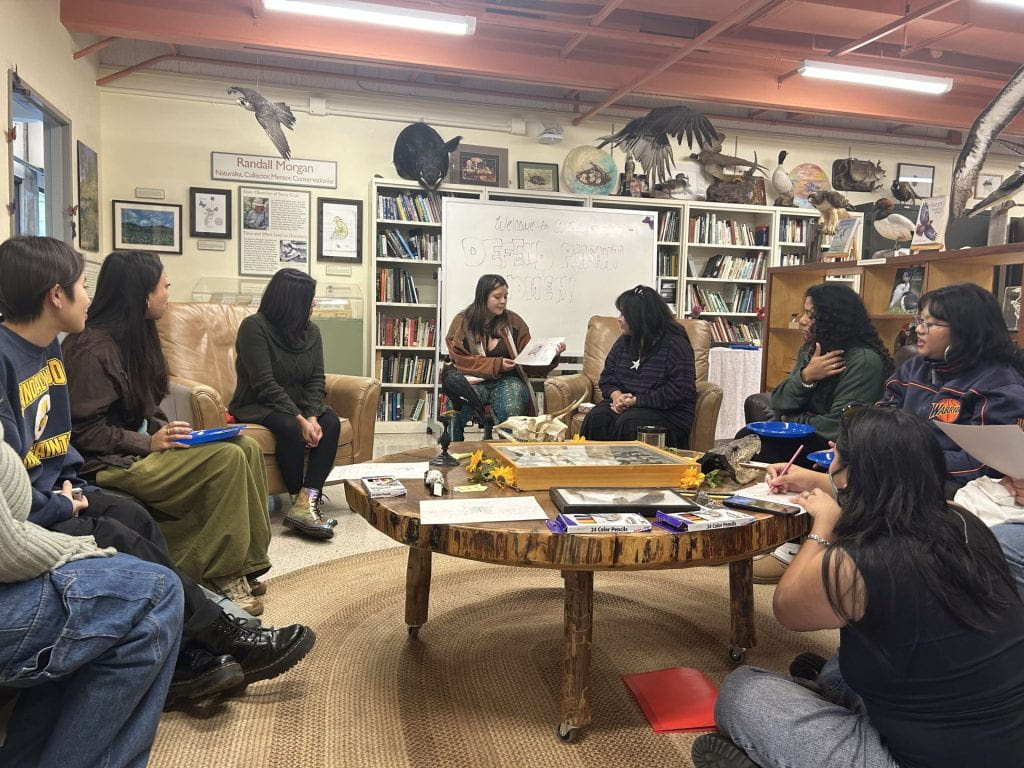
So when you walk in through the door of the Norris center, the first thing you see is a whole, whole wall on the left hand side of bookshelves.
And bookshelves are chock full of books on every topic that you can imagine about the natural world. So we've got books on birds and mammals and plants, but also on geology and stars and lichens and what kind of poop you're going to see when you walk through the woods and slime molds. Like almost any question that you can think of about natural history, if somebody knows the answer, the answer is probably on our bookshelf somewhere.
So that's on the left hand side. On the right hand side there is a circle of cozy leather couches.
And over in the corner there's a microwave so students can come in and warm up their lunch.
And there's a guitar. And usually there's at least a couple of undergraduate students lounging on the couches and they're chatting. Maybe they're talking about an insect that they just keyed out under a microscope next door. Maybe they're talking about the hike that they just came back from on the weekend.
It just feels like Chris was saying, it just feels like a place with community. And it makes me so happy every time I go in there.
You were asking about like, do we have exhibits? Especially like exhibits that would be special for kids. We don't have that kind of exhibit. But it is a very childlike space. So as you walk through the door, like in addition to the cozy couches, if you look up, the first thing you'll see is this enormous albatross hanging from the ceiling.
And on top of the bookshelf there's a big boar's Head. That is a real one.
And all around, there's like, cool skeletons and awesome rocks and birds nests and stuffed ducks. And just everywhere, there's just something cool to look at.
So it's really fun. And all our collections, our 130,000 specimens, they get their own special room. And in that room, which you have to have special permission to go into, it's a. It's just full of these enormous rolling cabinets which allow us to stuff like three times more stuff in there than you could normally get. And that whole room was. We're so lucky to have that really high level of safety for our collections. And we are very proud of that room. But the last thing I want to say is just that I think most people think when you think of museums and people who work in museums, you're probably thinking like very serious people, probably boring people. But we actually have a lot of fun at the Norris center. And we have all sorts of crazy stuff. It's like, very.
[00:47:00] Speaker A: Creative and funny to go in there. So. Yeah, for example, we have Winston the weasel.
[00:47:07] Speaker C: Who's Winston the weasel?
[00:47:12] Speaker B: Briefly. Winston the weasel was. Is a stuffed weasel. Which, by the way, there are long tail weasels in Santa Cruz.
[00:47:20] Speaker C: We actually had one on our back porch for a couple of days.
[00:47:23] Speaker A: Lucky you.
[00:47:24] Speaker B: Nice. Lucky you. Yeah, we see them on the campus every once in a while.
They often get run over, like, literally almost all the time. It's on Highway 1 and Western Drive. So many people have called me, like, there's a dead weasel. Let me guess where it is.
[00:47:41] Speaker B: So.
But we have a stuffed weasel. It's beautiful.
And during one of our public events, it got stolen.
One of a student stole it, thought it was cool, thought it would be nice to bring it home.
And I just was beside myself. I couldn't believe we lost the specimen. And through a long, humorous.
[00:48:06] Speaker B: Set of events, I called campus police and we put out a community crime bulletin.
And lo and behold, Winston got returned. After we did that, you know, we. We rubbed it in that Winston was our mascot and everybody loves Winston. And Winston got returned, and the. The police were so ecstatic that they, you know, actually called a crime. They called me up and they said, can Winston stay down here for a week?
And so I let the police down on lower campus have Winston for a week. And then Winston came home.
[00:48:42] Speaker C: Do you guys have any plans to build a standalone site for the center?
[00:48:48] Speaker A: Not a standalone site, but we do have plans.
We have big dreams.
[00:48:55] Speaker C: Well, I mean, I know how difficult it is to fulfill one's dreams at the University.
[00:49:03] Speaker C: What is your dream then?
[00:49:05] Speaker A: Well, actually, the university's been a good partner for us because we are getting a new room as of next year, an expansion space. And we're really excited about building this expansion space into a public facing.
[00:49:23] Speaker A: Space, space that will incorporate art and science and maker space and exhibit space and.
Yeah, so we're working on that. We have to do a lot of fundraising before we can get there.
[00:49:36] Speaker C: Well, is there anything else you want to add to all of this? Maybe you mentioned an event in January. Is that.
[00:49:42] Speaker B: Yeah, we got to invite people to our. So we, we do host a lot of events and every year we've been in the habit of having a public symposium which is open to students and the community.
[00:49:58] Speaker B: And so I do want to say a little bit about that.
[00:50:02] Speaker B: We really rely on our friends group. Remember we mentioned that at the beginning, Our friends group really helps us get the word out and get the community there. But we are having. You want me to talk about this or you want to talk about this?
[00:50:15] Speaker A: I guess I can jump in.
[00:50:16] Speaker B: Yeah, why don't you jump?
[00:50:17] Speaker A: Yeah. This year it's a really special culmination of a more than a decade long collaboration that we have with the UCSC Arboretum to support the Amamoxin Tribal Bands in their relearning program.
They have been kind of. Well, they are, let's see, how do I say this? They've been working on a series of botanical illustrations together with.
[00:50:49] Speaker A: Student artists that were chosen by the troubled bands and putting together their own text about cultural importance of California native plants.
And this year for our annual symposium, the theme is called Honoring our the Teachings of Plants.
And it's going to be coming along together with an exhibit at the Santa Cruz Museum of Art and History which will be opening the day before our symposium. So the event at the Museum of Natural history begins on February 13th, and then our annual symposium is on Valentine's Day in the afternoon.
[00:51:29] Speaker C: Is it at the barn or is.
[00:51:30] Speaker A: That where the hay barn.
[00:51:31] Speaker C: The hay barn on the campus.
[00:51:33] Speaker A: Easy to get. Park there easier.
[00:51:37] Speaker B: Yes, exactly.
[00:51:38] Speaker A: So it's been amazing to work with Alma Maudson Tribal Band.
[00:51:42] Speaker B: And you can, you can go to the Norris Center's website and I think right on the front page you'll see an advertisement for the event.
[00:51:51] Speaker B: And yeah, the whole community is invited.
We're gonna have a like a panel of indigenous speakers and we'll have some participatory things to do too. So it'll be fun.
[00:52:03] Speaker C: Okay. Well, Ingrid Parker and Chris Leigh, thank you so much for being my guests on Sustainability now.
[00:52:09] Speaker A: Thank you, Ronnie.
[00:52:10] Speaker B: Yeah, thanks, Ronnie. This was fun.
[00:52:12] Speaker C: You've been listening to a Sustainability NOW interview about the Kenneth S. Norris center for Natural History at UC Santa Cruz. My guests have been Dr. Ingrid Parker, Faculty director of the center, and Chris Ley, the center's administrative director.
If you'd like to listen to previous shows, you can find them at ksquid.org sustainabilitynow and Spotify, YouTube and Pocketcasts, among other podcast sites.
So thanks for listening, and thanks to all the staff and volunteers who make K Squid your community radio station and keep it going. And so, until next every other Sunday, sustainability Now.
[00:52:56] Speaker A: Good planets are hard to find out.
[00:52:59] Speaker B: Temperate zones and tropic climbs and run through currents and thriving seas, winds blowing through breathing trees, strong ozone and safe sunshine.
Good planets are hard to find. Yeah.